New research from the UCLA Center for the Transformation of Schools details rising homelessness among youth, fading resources
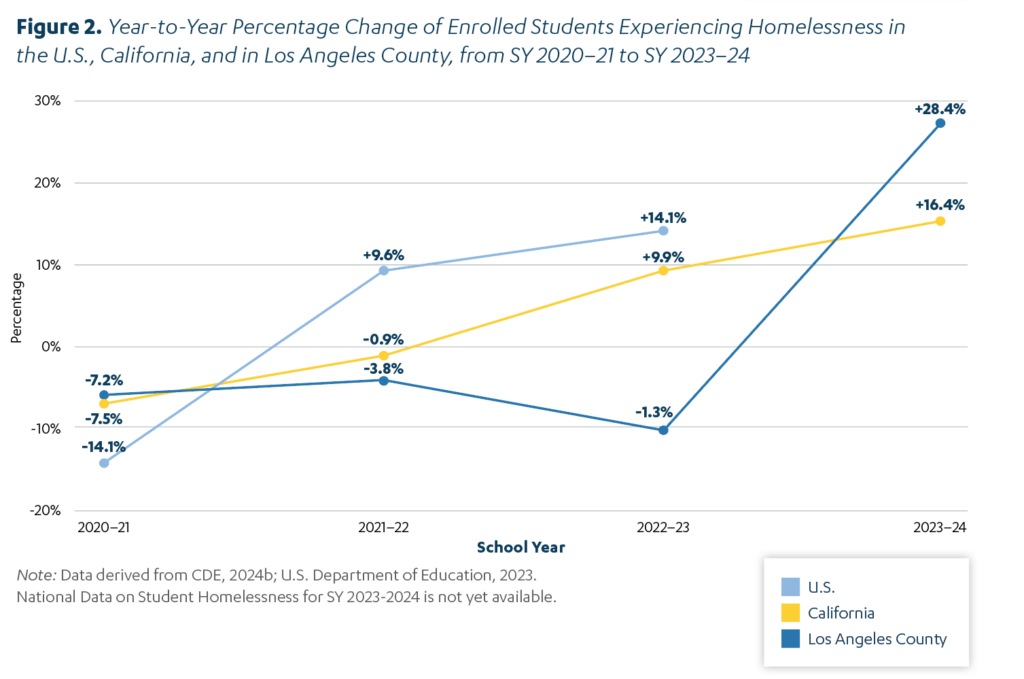
Between school years 2022–23 and 2023–24, student homelessness rose 30 percent in Los Angeles County, according to a new analysis by the UCLA Center for the Transformation of Schools. An estimated 61,249 students experienced homelessness in the county during the 2023–24 school year. The rate of student homelessness in the county significantly exceeds the percentage of student homelessness in California which saw a 16 percent increase between 2022–23 and 2023–24, according to the California Department of Education.
“Los Angeles County is facing a rapid escalation in youth homelessness,” says Mayra Cazares-Minero, a research analyst at the Center for the Transformation of Schools and an author of one of the new research briefs. “A shortage of housing, economic instability and other barriers is making access to housing more difficult, just as important temporary funding streams and policies supporting access to housing are expiring.”
One of the two research briefs “Rising Numbers, Fading Resources: Students Experiencing Homelessness in Los Angeles County,” is an analysis of data on student homelessness released last year by the California Department of Education to provide a more detailed look at student homelessness in the state and across Los Angeles County. In doing so, the paper details higher rates of homelessness among Hispanic and Black youth, as well as across grade levels. The study also examines other population characteristics including English Language Learners, migrants and those with disabilities. Homeless students also experience higher rates of chronic absenteeism, higher dropout rates and lower achievement on mathematics and English testing.
Among the Findings:
- Latino/a students are disproportionately likely to experience homelessness. In the 2023-24 school year, 3 in 4 students experiencing homelessness in Los Angeles County were Latino.
- Almost 12 percent (11.5) of Los Angeles County students experiencing homelessness were Black in the 2023-24 school year. That number is marginally higher that than the average statewide, by substantially lower than the national proportion of Black students experiencing homelessness (25%) recorded in SY 2022-23.
- In SY 2023-24, students classified as English Learners represented 34% of students experiencing homelessness in Los Angeles County.
- Chronic absenteeism affected over a third of students experiencing homelessness in Los Angeles County (37.2%) and California (36.3%), significantly higher than the chronic absenteeism rates among the general student population.
The research brief also identifies the ten school districts in Los Angeles County with the highest rates of student homelessness. Norwalk-La Mirada Elementary School District reports nearly one in three students unhoused. Three of the five districts with the highest homelessness rates (Wilsonia Unified, Rowland Unified, and Mountain View Elementary) are in the San Gabriel Valley.
An additional study, “Hidden in Plain Sight: Fear, Underidentification, and Funding Gaps for Housing-Insecure Students in Los Angeles County,” explores the perspectives of staff who are charged with supporting the educational success of students experiencing homelessness in six Los Angeles County school districts and the Los Angeles County Office of Education, providing timely insights into the effectiveness and shortcomings of current systems during a period of rising student homelessness in the region. The qualitative study draws on interviews with seven school-based homeless liaisons and county officials across five districts to examine identification practices, service barriers, and data systems. Findings show major challenges in accurately identifying students due to inconsistent, subjective processes. Many families avoid self-identification because of stigma, fear of child welfare or immigration consequences, or confusion about eligibility. Fragmented data systems further hinder verification and coordination, while inadequate federal funding forces reliance on unstable grants and donations.
“The concentration of student homelessness in specific regions—particularly in the East and San Gabriel Valley—suggests that homelessness is not evenly distributed across Los Angeles County and is shaped by localized factors such as housing costs, community disinvestment, and service gaps,” said Joseph Bishop, executive director of the UCLA Center for the Transformation of Schools and an author of the research paper. “Deeper county and district-level analyses are needed to better understand the scope of the crisis and design targeted, effective responses.”
“On a larger scale it is unclear how California—or the nation as a whole—will continue to support students experiencing homelessness, especially as numbers continue to rise while funding and focus is fading,” Bishop added. “It is essential that California and Los Angeles County take urgent, coordinated action to address homelessness among youth.”
Both studies offer specific recommendations that outline targeted strategies for state, county, and district leaders to strengthen identification, expand supports, and reduce systemic barriers for these students. Among other actions, the authors urge sustained, targeted investments in housing supports, expansion of McKinney-Vento services, and district-level programs that improve attendance, stability, and academic outcomes.
“Strengthening trauma-informed identification, integrating data systems, stabilizing funding for direct supports, and formalizing cross-sector partnerships are critical to improving outcomes for unhoused students,” said Adriana Jaramillo Castillo, a research analyst at the UCLA Center for the Transformation of Schools and a lead author of the study.
Both studies with recommendations are available on the Center for the Transformation of Schools website at https://transformschools.ucla.edu/research/hidden-in-plain-sight-fear-underidentification-and-funding-gaps-for-housing-insecure-students-in-los-angeles-county/ and https://transformschools.ucla.edu/research/rising-numbers-fading-resources-students-experiencing-homelessness-in-los-angeles-county/.
###
News Media Contact: John McDonald – jmcdonald@gseis.ucla.edu