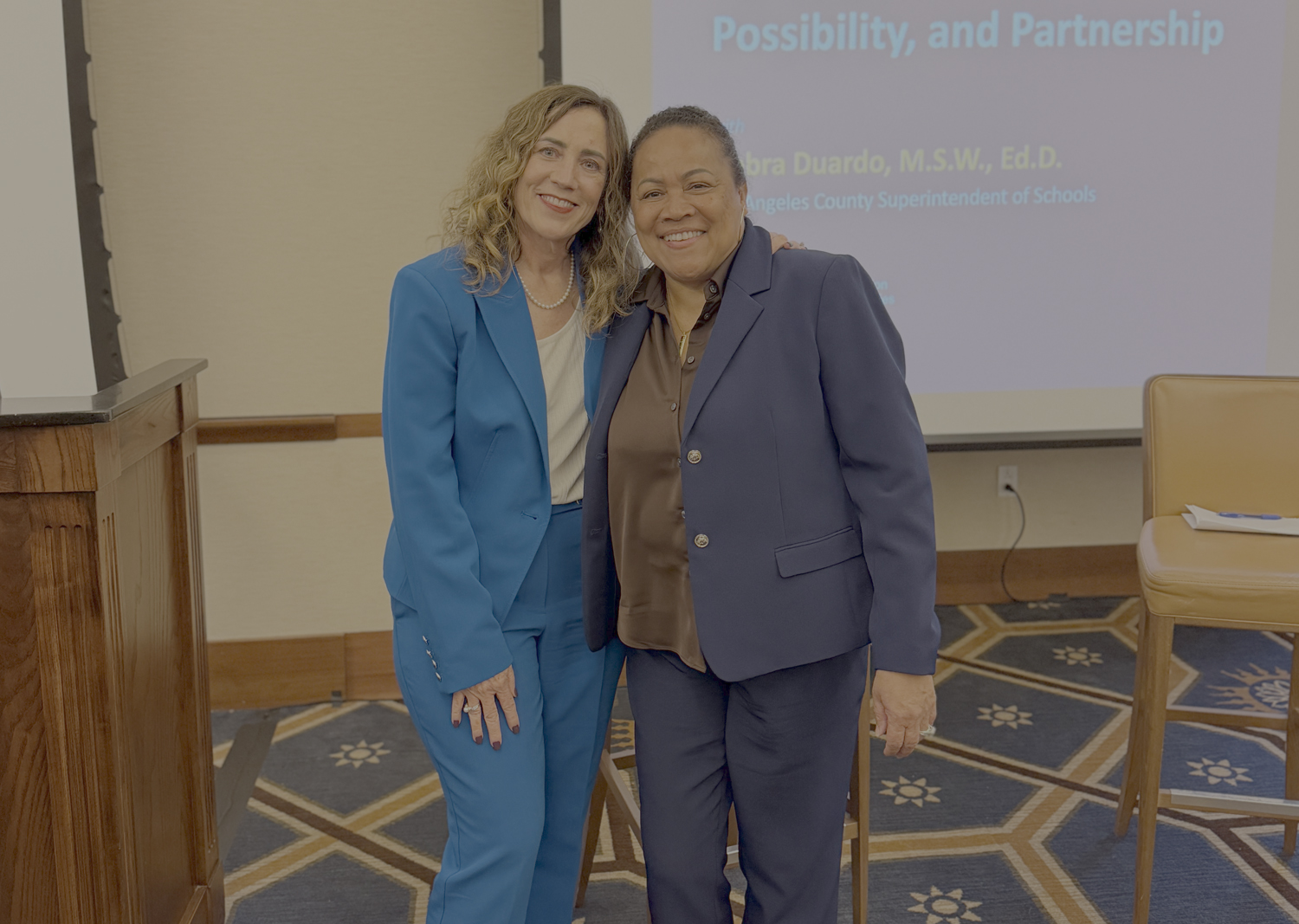
Superintendent of LA County Office of Education and UCLA alumna shares perspectives on community schooling, partnerships across institutions to create the schools the county needs.
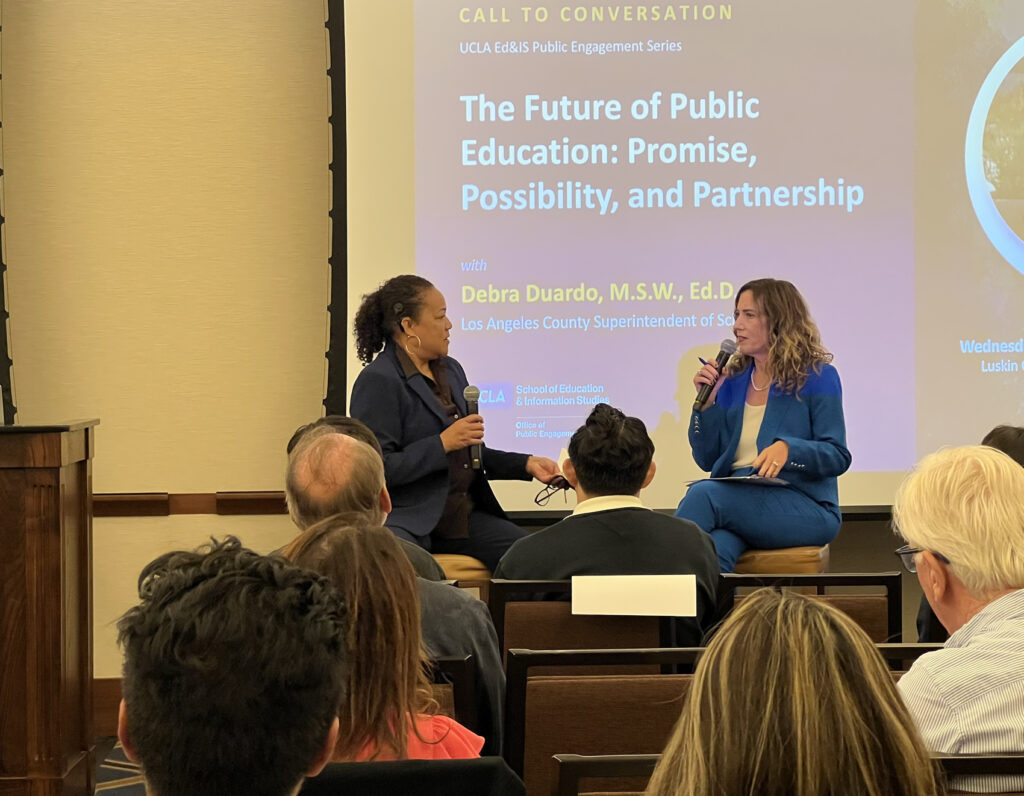
Superintendent Debra Duardo of the Los Angeles County Office of Education (LACOE) took part in a conversation with Annamarie Francois, associate dean for public engagement at the UCLA School of Education and Information Studies on Oct. 28 at the Luskin Center. The event, part of the “Call to Conversation” series created by Francois, focused on “The Future of Public Education: Promise, Possibility, and Partnership.”
Duardo, a triple Bruin with her BA, MSW, and EdD from UCLA, discussed the work of LACOE and the impacts of strengthening partnerships between schools, districts, and universities, particularly in the community schooling model.
Christina Christie, dean of the UCLA School of Education and Information Studies, says that the “Call to Conversation” series “brings public leaders into dialogue with our school about the most consequential questions facing education. We think of it as an exercise in democratic engagement; a chance to listen, to ask questions together, and to work towards solutions that make sense to all of us who are grappling with them.”
Dean Christie welcomed the audience, delineating the School’s strategic priorities in the context of partnerships across UCLA and beyond campus, including strong public schools and a thriving educator workforce; youth, family, and community wellbeing; democracy, belonging, and civil rights; technology, AI, and information for the public good; and evidence, accountability, and public trust.
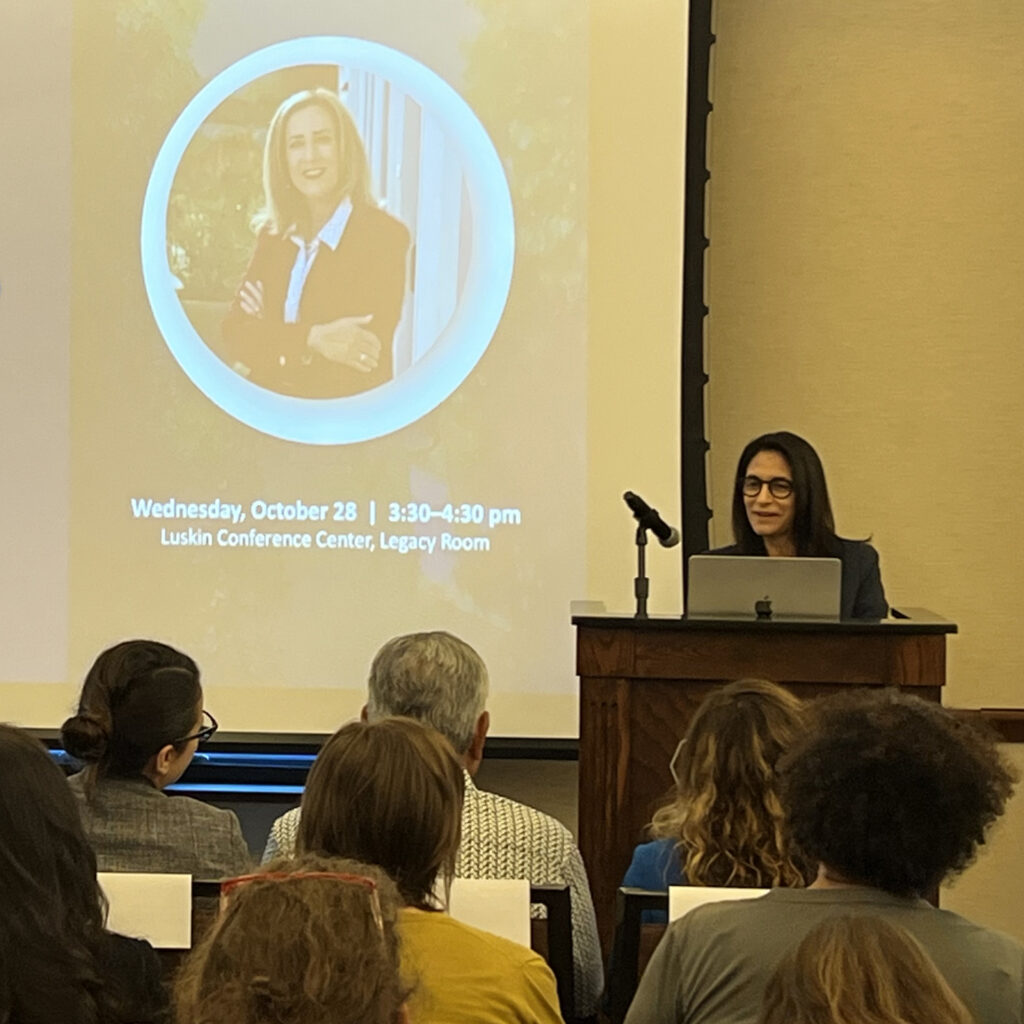
“Public education is still one of the best promises this country has made to its children,” she said. “Keeping that promise will take schools, universities, families, and neighborhoods working at it together. Together, they reflect our conviction that the conditions in which young people learn and live can’t be separated and that our scholarship has the greatest impact when it is carried out in partnership with educators, families, and public leaders working to improve both.”
Duardo, who leads the largest regional education agency in the nation, oversees 80 TK-12 districts, which serve 1.3 million students in the most populous and diverse county in the U.S. She was honored in 2023 with the Harold W. McGraw, Jr. Prize in Education for her innovative leadership in equipping school superintendents and school leaders for LACOE’s “whole child” approach to education.
Duardo underscored the importance of “understanding the community that you serve, doing everything through a lens of equity and identifying what the needs are.
“I really believe in serving the whole child and the family,” she said. “So for me, it’s also making sure our schools are safe; that students feel a sense of belonging; that there is relevance in what they’re learning; that they have a voice, and that we have programs to support our students.”
Duardo noted that some of the most pressing needs across L.A. County include the need for mental health supports for students, teachers, and school staff; chronic absenteeism, immigration issues, including fear around ICE raids; declining enrollment, and limited resources. She also addressed the need to solve the achievement gap, and “…figuring out ways to serve all our students so they can meet their full potential.”
Duardo said that California has invested a great deal of financial resources in community schooling, and described a LACOE pilot program that was created in 2019. Working with the Department of Mental Health, community-based agencies, and supervisors, the program was aimed at determining the needs of students as well as what were the highest need districts that would benefit from the community school model.
“We know that students spend so much time at school [and] that schools are places where families feel more comfortable accessing resources and they’re more likely to access them if they are at their schools,” said Duardo.
“It’s more than just services. It’s a change in your leadership philosophy. It’s inviting parents and students and community members to have a voice in the decisions that are made that are going to impact them directly. It’s about using schools, not just during the day but opening your schools so that they are an asset to the community.”
LACOE is the lead agency for Los Angeles County in supporting districts and schools to apply for community school grants, working in partnership with the Center for the Transformation of Schools at UCLA. In addition, the UCLA Center for Community Schooling is the state technical assistance partner for California.
“I feel really excited that we piloted it here and that it’s grown across the state,” said Duardo. “I really believe [community schools are] a model for how all schools should run.”
Duardo discussed the role of community school coordinators, who also serve as a family liaison, in order to alleviate already-overburdened teachers and principals from more responsibility.
“You can’t just dump another thing on a school where you have a principal, by themselves trying to run the school and on top of that, how to engage partners, how to find office space for partners, how to do a consent form and MOUs with partners. None of us can do this work alone. The need is so high… because if their students are healthy – physically and emotionally, and safe, they’re more likely to learn from the wonderful instruction that [teachers are] providing.”
Duardo stated that universities can contribute to the advancement of public education greatly by “sharing resources, convening, understanding what the front lines are saying.
“You’re doing an incredible job preparing teachers to come into the field,” she said. “Universities do an excellent job in terms of studying issues, research. What I think would be really helpful is making sure that they are communicating with practitioners so that they understand what is important to the practitioner… the people who are there every day, working with students, working with families, struggling with the challenges that are taking place in schools and making sure that they are having that conversation and talking to one another. It’s doing what you do best… but making sure it’s done in a way that it’s not just a research article or a dissertation.”
Asked what she hopes for schools across Los Angeles County in the next 10 years, Duardo said that she aspires to continue the fight for equity, close the achievement gap, and improve conditions in schools that hinder learning, including personal safety and an end to violence, discrimination, and bullying, equity in technology, parental belonging in schools, and considering students’ voices and happiness.
“We still have too many children – low-income, children with disabilities, children of color – that the systems weren’t designed to meet their needs and we need to better understand what those issues are and change those systems,” said Duardo.
Above: Superintendent Debra Duardo, Los Angeles County Office of Education (at left), joined in a “Call to Conversation” discussion with Annamarie Francois, associate dean for public engagement at the UCLA School of Education & Information Studies, at UCLA’s Luskin Center on Oct. 28. Photo by Paolo Cantos