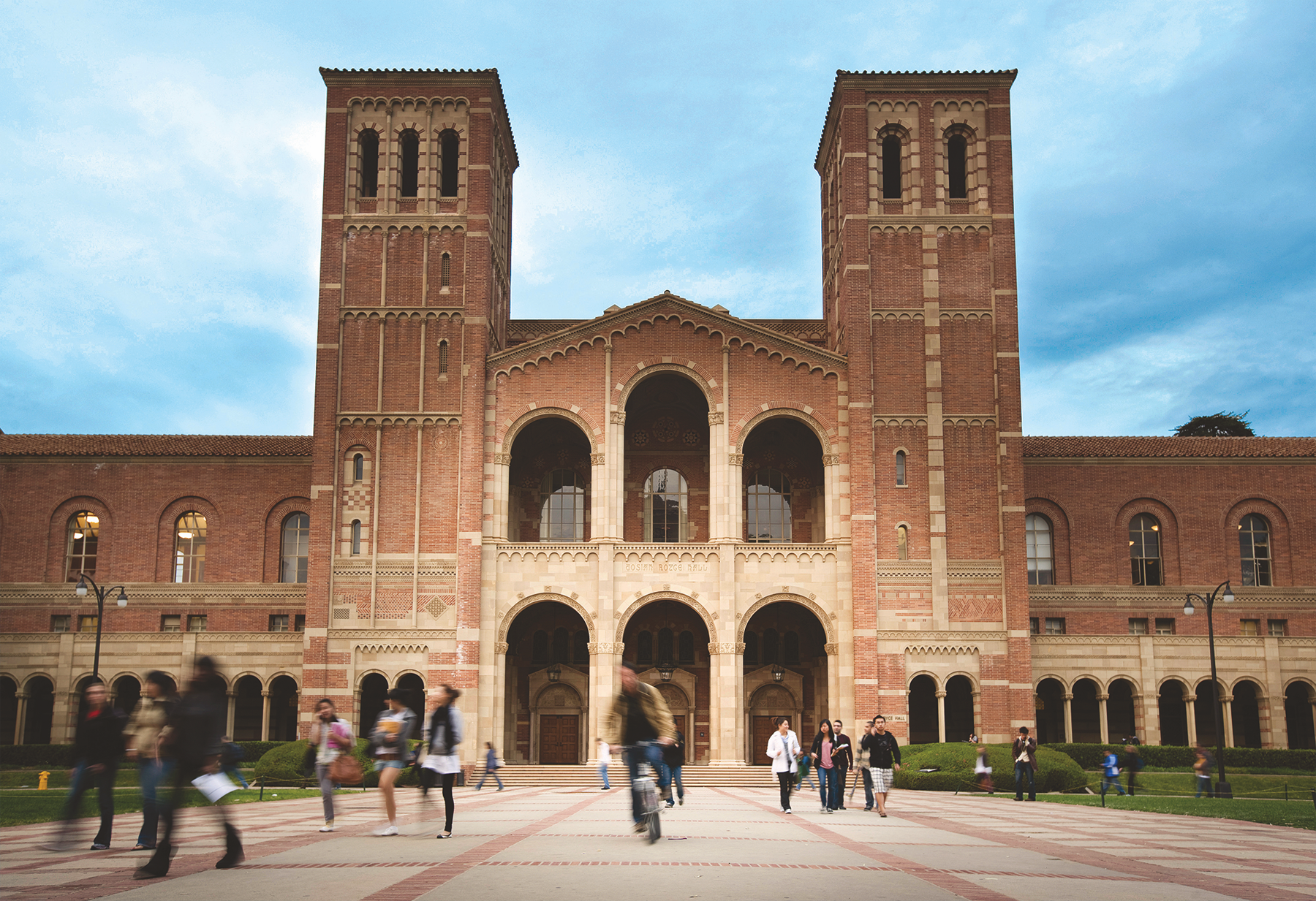
Students collaborate with UCLA undergrads across disciplines to explore pressing questions and support academic success.
Students majoring in UCLA’s Education and Social Transformation program took part in the University’s Undergraduate Research Week, May 18-22, showcasing collaborative work that undergrads across UCLA disciplines have done to examine pressing questions in educational research and to find ways to improve school environments for academic success.
Three presentations were livestreamed on May 19. Rachel Doerfler presented ‘UCLA? I can’t make it’: Effective Curriculum Support for High School Students with Varying Immigrant Status in Koreatown,” with UCLA undergrads Jenny Thai, Hamza Lahib, and Brooklynn Ming. The team was mentored by Jason Dorio, associate director of Undergraduate Programs for Community Engagement at UCLA Ed&IS.
The team’s year-long community based participatory action research project at a local high school in Koreatown was guided by questions on the unique college-going needs of high school students with varying immigrant statuses, and how these needs can be reflected in the curriculum and instruction of college and career preparation courses. Their research examined college-access challenges and assets prevalent amongst immigrant students enrolled in high school college-preparation courses, investigated curriculum and instruction design, and offered recommendations.
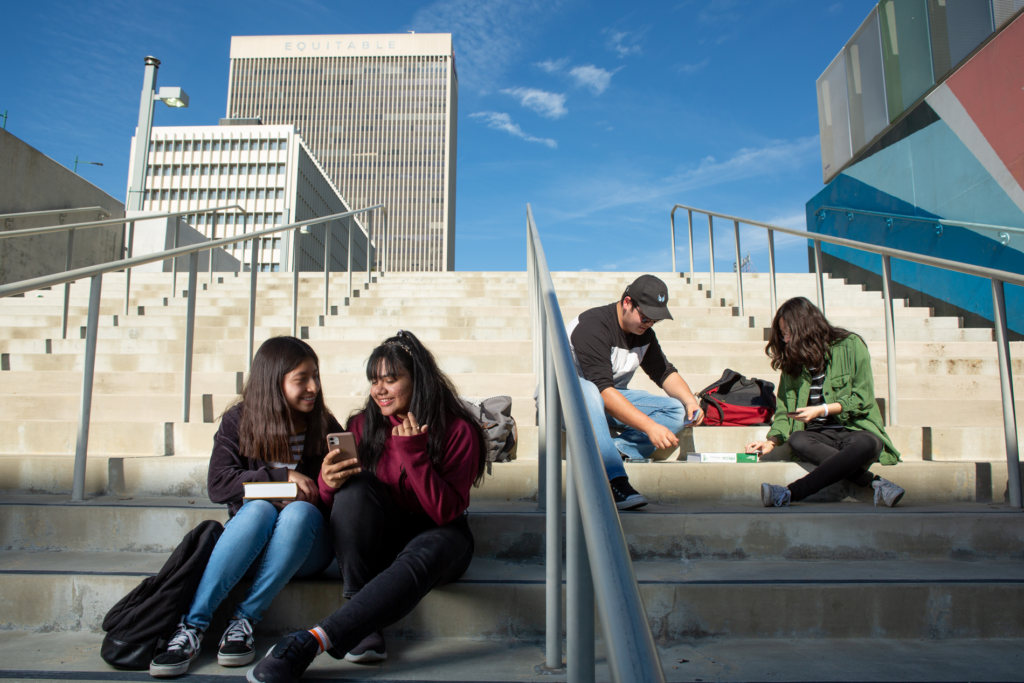
Findings showed that students benefit from culturally responsive instruction, community asset-based mentorship, accessibility of instruction through home language, and recognition of the way external factors affect classroom engagement. The researchers offered recommendations for support of students of varying immigrant status, especially first-generation or low-income students, to increase college and career success.
Doerfler said that working in tandem with fellow UCLA undergrads from across campus not only enhanced their research but delivered the message that a school like UCLA was within reach.
“A lot of the [high school] students … had dreams of going into business [and] so many different things,” she said. “I believe that having different co-researchers from different departments – psychology, political science, labor studies – helped to broaden the perspective on college and career readiness. It helped allow students to see themselves a little bit more because we’re all from different backgrounds. I think that helped [us in] being able to connect with all the students.”
“All of us didn’t necessarily think that UCLA would be attainable for us, but we made it this far and here we are,” said Doerfler. “And it’s not just UCLA – it’s also other prestigious universities and universities in general, that these students feel that they cannot attain… partially because they don’t want to be far from their family. They don’t know how to navigate the certain barriers that might be in their way, and all these other things. So, I think that people from these different disciplines, the fact that all of us were able to come together, added nuance not only to the research process … but also, just to connect to the students a little bit deeper, in all aspects.”
“Going into the classrooms and talking to the students… a lot of them felt that UCLA wasn’t attainable,” said Ming, a transfer student with a double major in political science and labor studies. “When I was in high school, I didn’t think I could make it to UCLA. Being a transfer student, I encouraged them to look at the community college pathway as well.”
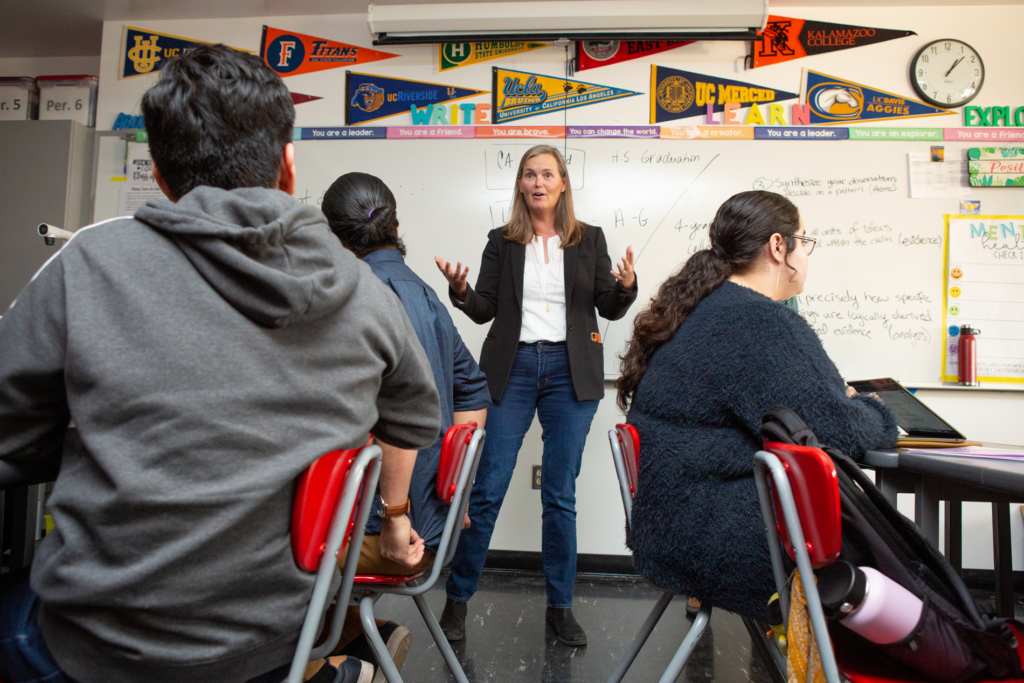
Along with Karen Hunter Quartz, director, UCLA Center for Community Schooling and adjunct professor; and Cinthya Salazar, assistant professor of education, Dorio oversees 16 UCLA undergraduates on different teaching and research teams at UCLA Community School and Mann UCLA Community School.
Dorio, who mentored Doerfler and her research team for a year on this project, said that students at the two community schools “have have a lot of touchpoints with UCLA students on a variety of things – research, teaching, and engagement. Just having that mentorship and being able to see students who have similar interests as well as similar struggles and challenges is, I think, overall, very helpful and rewarding to the students.
“Letting them know that there are a variety of pathways, whether it’s community college [or] four-year [universities], and giving them information needed to make that informed decision with their families … means so much to the students, as well as to the teachers,” Dorio said.
Doerfler also presented “Our Relationship to the Classroom: Student Agency and Reciprocity for Environmental Education,” with UCLA undergrads Mollie Isaacson and Sylvia Ke. Their project was mentored by Christine Lee, associate project scientist at UCLA CONNECT. Their study examined how an elementary teacher implemented inquiry and environmental education to support her students in acquiring environmental responsibility for their classrooms and beyond.
The research team used data from interviews with a 3rd and 4th grade teacher who has been engaged in a year-long inquiry on healthy indoor air qualities, specifically CO2. Their analysis revealed two main themes of student agency and reciprocity in the classroom to support environmental action, including going outside to air out the classroom, opening windows, and walking into the classroom calmly to mitigate the buildup of CO2 after strenuous physical activity during recess. The researchers found that students came to understand their relationship with the classroom as mutual and interdependent, and recognized that their behaviors directly affected the classroom and that the classroom, in turn, had a role in their well-being.
Arianna Zamora, with UCLA undergrads Mmesoma Ozokolie, Naomi Higareda, and Laurence Matienzo, presented, “Cultivating Identity, Belonging, and Futures in Black and Brown High School Students Through Curriculum.” The research team, which was also mentored by Dorio, explored how culturally responsive teaching and mentorship during high school can lead to positive higher education retention and postsecondary success for Black and Brown students. Their year-long community-based action research project at Mann UCLA Community School examined how curriculum is used to support students’ college and career aspirations.
Zamora and her research team – being themselves first-generation college students of color, from low-income, bilingual, and single-parent households – served as college access interns and co-teachers during the project. Their analysis of culturally-responsive teaching and mentorship through student artifacts, surveys, focus groups, and observations suggested the need for nurturing a strong sense of identity, preparedness, and knowledge about college and career within post-secondary curriculum for underrepresented communities. In addition, their study showed that students are more likely to stay in college and other career-oriented spaces when they feel a sense of academic and social belonging.
Zamora, who is graduating this month with a double major in psychology and education and social transformation, is a Bruin Advisor for the Early Academic Outreach Program, which supports underrepresented students. She tells students to see their cultural capital of being bilingual, translating for family members, and often, as the oldest child, being a caregiver for siblings and other family members, as an asset.
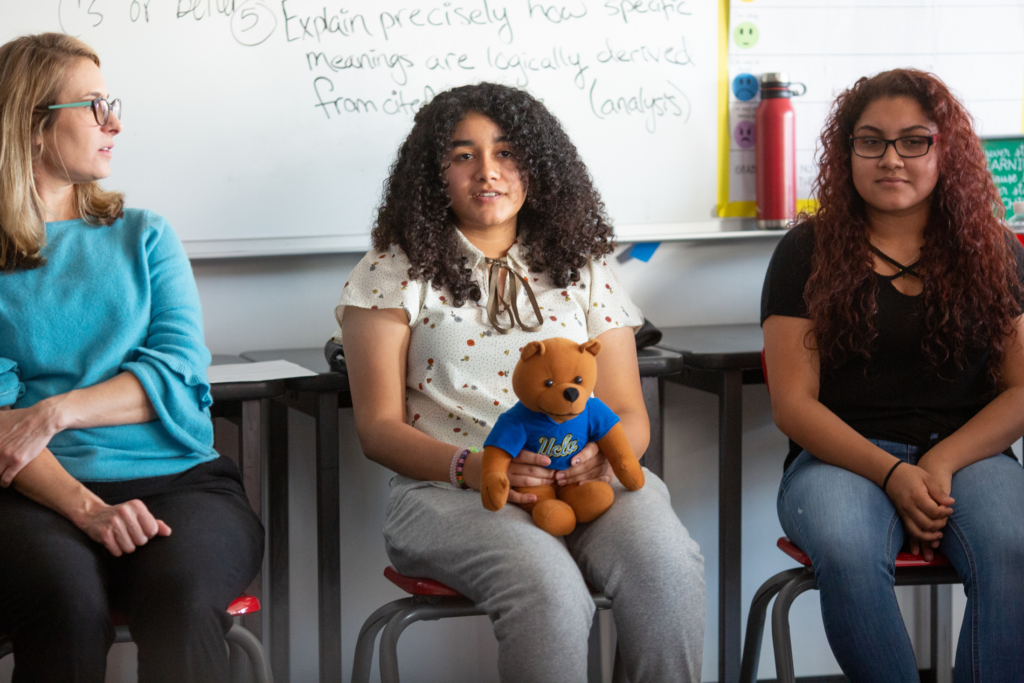
“I realized that I didn’t think about that for myself [as a student], being first-generation, low-income,” said Zamora. “I also grew up taking care of my siblings and family members. It’s a very big deal that not a lot of students seem to recognize … and that is something they can put on their college applications.”
“Our relevant aspect of delivering these college and career lessons was our own positionality,” said Higareda, a fourth-year student majoring in sociology and minoring in education studies. “That was really huge in terms of our research and being able to incorporate… these perspectives that we bring to the table toward our project.”
The following presentations were recorded and made available to view during Undergraduate Research Week:
Sabah Alidina, psychology major minoring in education and social transformation, presented “Empowering Students Early: The Role of Self-Efficacy in Career Readiness,” mentored by Karen Hunter Quartz.
Claudia Castruita presented, “En sus propias palabras: Understanding the Postsecondary Experiences of Formerly Incarcerated Latinas in California,” mentored by Julissa Muñiz, assistant professor of education. Castruita also presented this work at the annual meeting of the American Educational Research Association (AERA) in April.
Sam Ferraez Diaz presented, “No one wants to be within this system”: The Importance of Critical Consciousness in Reclaiming a Liberated Identity Post Incarceration,” also mentored by Professor Muñiz. Stephanie Garibay presented, “Supporting Emergent Readers in Perspective Taking Through Wordless Books,” also mentored by CONNECT’s Christine Lee. Diaz also presented this work at the annual meeting of AERA in April.
Julian Jenkins presented “Beyond the Classroom: Repositioning Youth of Color as Critical Researchers and Civic Interrogators through Critical Civic Action Researcher Identity,” mentored by Tyrone Howard, professor of education. (Watch Jenkins’ prerecorded presentation on YouTube.)
Ellen Kim presented, “5 Years Forward: Progress and Partnership at the Intersection of Child Welfare and Domestic Violence,” mentored by Brenda Tully, research director for the UCLA Pritzker Center for Strengthening Children and Families.
Valeria Luquin presented, “Feeling in-between: An examination of the diverse lived realities of the commuter student experience, mentored by Jeff Share, senior lecturer in the UCLA Teacher Education Program.
Geidy Nunez presented, “Roots and Roses: Mapping Historical Segregation and Contemporary Graduation Rates with Higher Educational Opportunity in LAUSD High Schools Across Regions,” mentored by Lorena Guillen, lecturer in the UCLA Department of Education.
Sara Vazquez presented, “Lessons on Teaching and Learning from Jazz Musicians: Relationships and the Creation of Collaborative Spaces in Classrooms,” mentored by Ananda Marin, associate professor of education and vice chair of graduate education.
Faculty members and researchers from the UCLA School of Education and Information Studies provided expertise and support for UCLA undergrads across disciplines, including Walter Allen, Distinguished Professor of Education, Sociology, and African American Studies and the Allan Murray Cartter Chair in Higher Education; Chris Jadallah, assistant professor of environmental justice in education; Jill Locke, associate professor in resident, UCLA Department of Education; Cindy Nguyen, assistant professor, UCLA Department of Information Studies and UCLA Digital Humanities Program; Federica Raia, associate professor of education; Julie Schneider, associate project scientist, UC|CSU Collaborative for Neuroscience, Diversity, and Learning; Daniel Solórzano, professor of education and Chicana/o and Central American studies; and Ivy Zucaya, research director, UCLA Pritzker Center for Strengthening Children and Families.