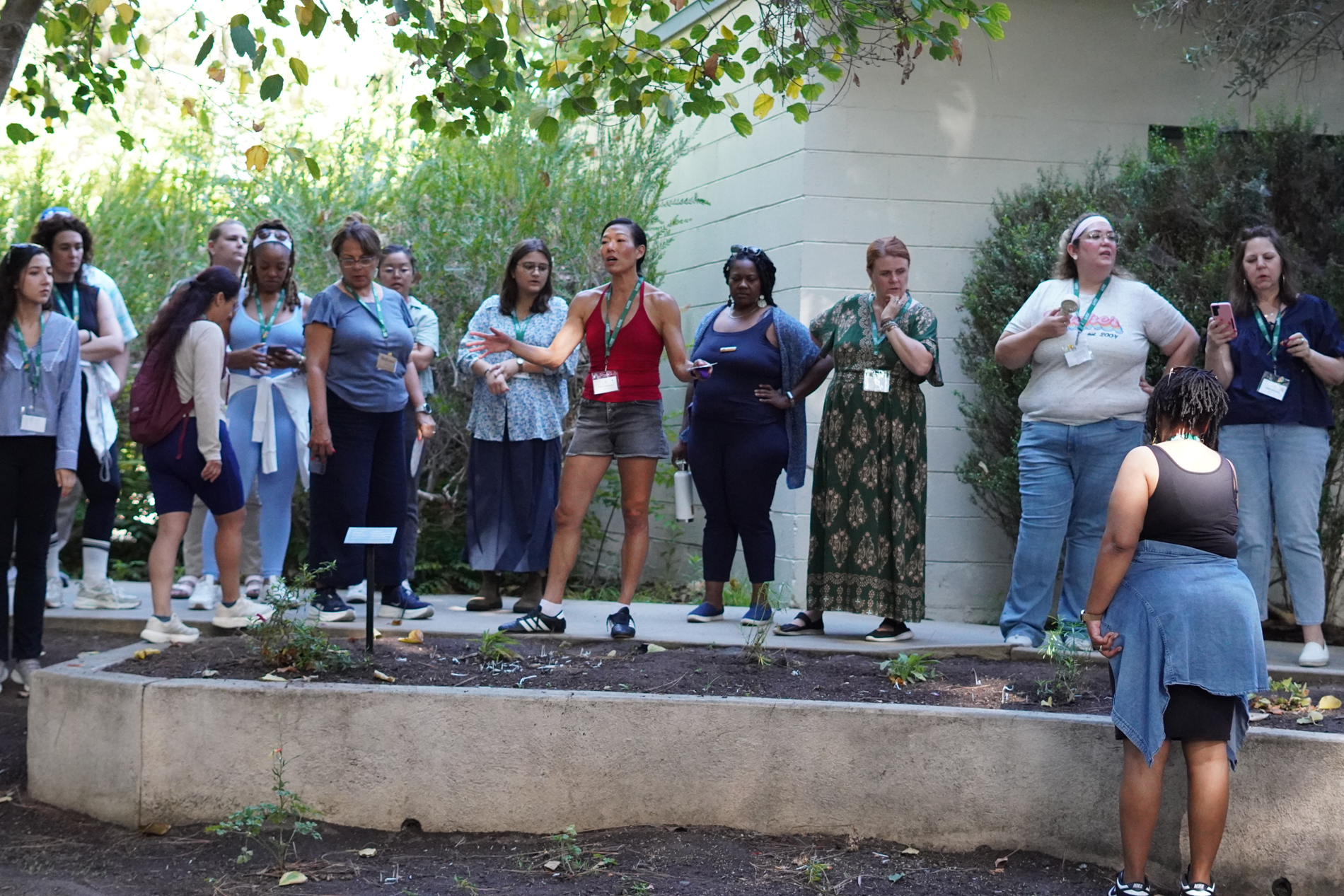
Hosted at UCLA, EcoRise’s Summer Institute prepares teachers and school leaders to embed sustainability and environmental education in classrooms.
Over the last nine years, the EcoRise Summer Institute has prepared K-12 educators and school leaders to bring environmental education to their classrooms. EcoRise is a nonprofit dedicated to incorporating sustainability and climate literacy into K-12 education. UCLA School of Education and Information Studies, the Rob Walton College of Global Futures at Arizona State University (ASU), Niagara Cares, Southwest Airlines, and the Green Schools National Network are co-sponsors of this year’s EcoRise Summer Institute.
The partnership with UCLA’s Department of Education, which began in 2022, continues to help shape programming for EcoRise’s Teacher Ambassador Program and the growing Green School Leadership Cohort, reflecting a shared commitment to advancing sustainability and environmental education.
In 2025, the Summer Institute was held at UCLA, the first time it took place outside of EcoRise’s home state of Texas, reinforcing the critical role of UCLA’s Department of Education in supporting K-12 engagement to bring about research-based teaching and learning and lasting social change.
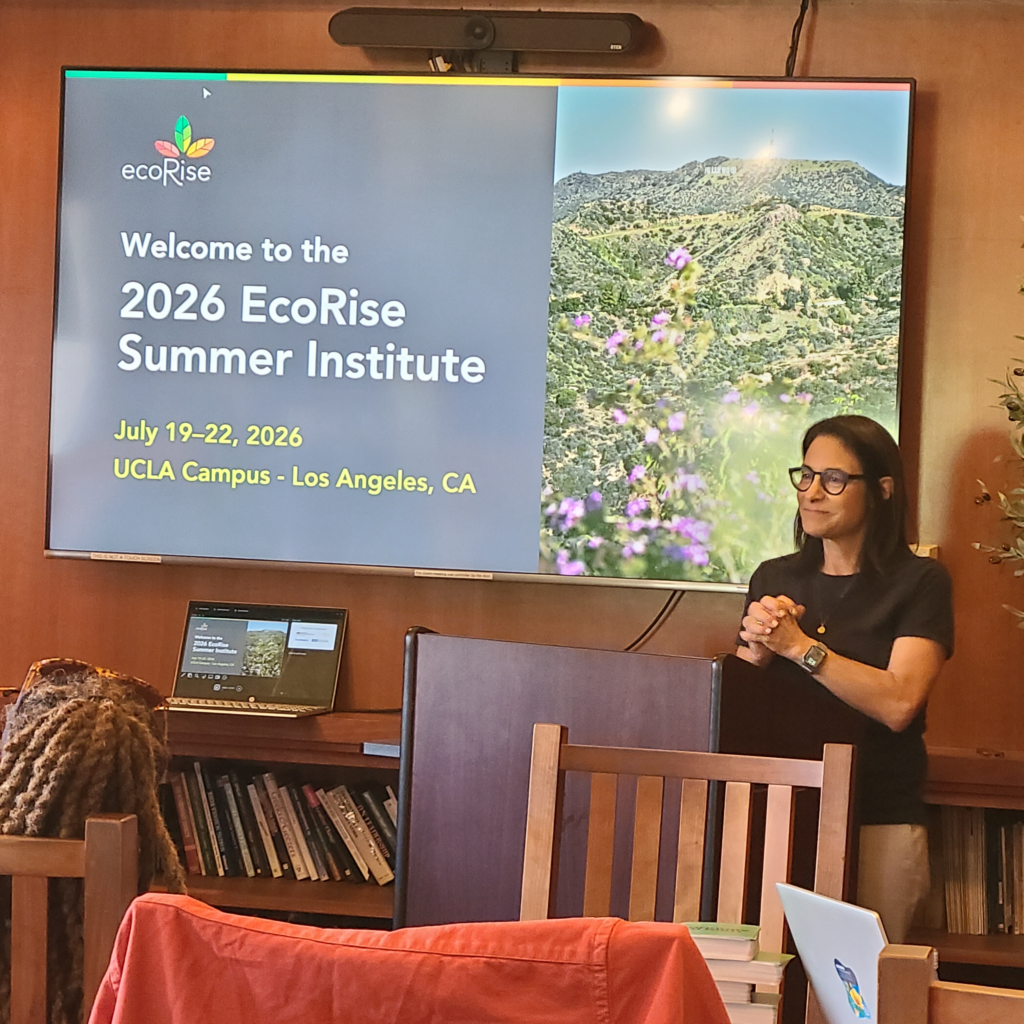
“Last summer we made the connection that linking higher ed and the work EcoRise was already doing with K-12 teachers was an evolution that made sense,” said Sarah Bang, director of P-12 public school partnerships at UCLA Ed&IS. “It helped teachers link their work with research and academia. Teacher feedback included feelings of ‘their work being validated by UCLA faculty.’”
This year, the Summer Institute took place in Moore Hall, July 19-22, with Rob Walton College of Global Futures, joining for the first time through its Sustainability Teachers Academy.
Christina Christie, dean of UCLA Ed&IS, welcomed the participants, among them K-12 teachers, school administrators, and program partners from across the U.S., including Texas, California, New York, Oklahoma, and Washington, D.C., to UCLA Ed&IS.
“The Senegalese environmentalist Baba Dioum wrote, ‘In the end, we will conserve only what we love; we will love only what we understand; and we will understand only what we are taught,’” she said. “This is the spirit in which we approach our work with EcoRise and ASU. It focuses not just on what we teach, but how. What is taught will change as we learn more about the climate crisis and how we can best mitigate it.
“How we teach – the pedagogical force we use in solving the climate crisis – is equally essential,” Dean Christie said. “A swift shift towards a model of education that fosters a generation of informed community members who think critically and act creatively, equipped with the knowledge, skills, and ethical frameworks, is necessary to save the planet. We are thrilled to be engaged in this effort.”
Bang said that “Hosting the EcoRise Summer Institute at UCLA ED&IS was a wonderful opportunity to deepen our partnership with EcoRise—a thoughtful and collaborative partner that consistently brings together educators, researchers, and community leaders around a shared commitment to environmental literacy and student agency.”
The Summer Institute program includes activities and sessions to prepare teachers and administrators to share EcoRise’s mission and vision, and to implement EcoRise’s resources for K-12 classrooms and school districts, aimed at fostering eco-literacy and student innovation. Incorporating wellness and comradery into educators’ personal and professional lives was also incorporated into the sessions.
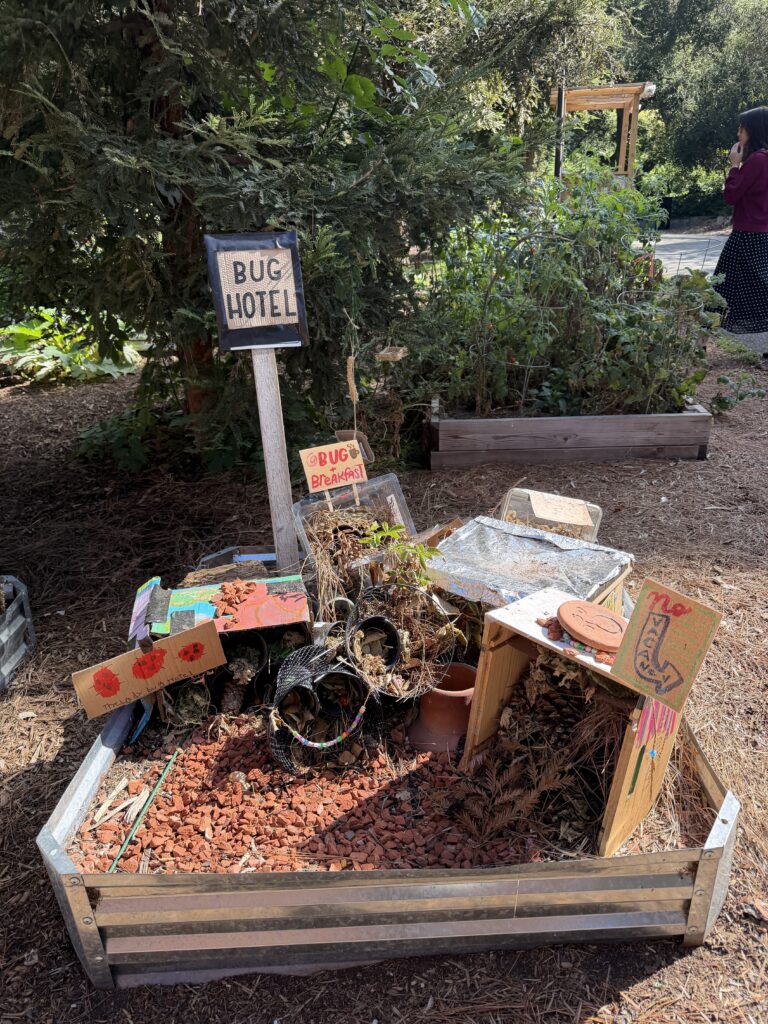
Noelani Ogasawara Morris, a primary level teacher at UCLA Lab School who has been a Teacher Ambassador since 2023, is participating in EcoRise’s program to prepare K-12 educators to become environmental education leaders. Teacher Ambassadors comprise a national cohort focused on place-based climate education, systems thinking, and community-driven design curricula. With these tools, they learn pedagogical and leadership skills to bring climate, sustainability, and environmental justice into K-12 classrooms.
Because a school’s culture, policies, and budget shape whether sustainability efforts actually stick, EcoRise partnered with UCLA Ed&IS and the Green Schools National Network in 2025 to launch the Green School Leadership Cohort, an administrator-focused track that has become a cornerstone of EcoRise’s national leadership strategy. The Leadership Cohort brings together forward-thinking school leaders who can scale sustainability initiatives beyond a single classroom by shaping school culture, aligning policies, and creating the conditions for teachers and students to thrive.
This year’s Summer Institute began with a keynote by Darlene Tieu-Forster, science teacher at Mann UCLA Community School on the importance of rooting environmental education and science in general in local historical contexts to make it relevant to students and empower them to be changemakers in their own community.
“The Ecorise Summer Institute is implementing amazing environmental education curriculum across the country and I was honored to have the opportunity to share a glimpse of what that looks like in South Central Los Angeles,” said Tieu-Forster. “It was such a pleasure to get to share the story of South Central Los Angeles with educators from across the country and I learned so much in talking to the participants and was inspired by the work that they are doing.”
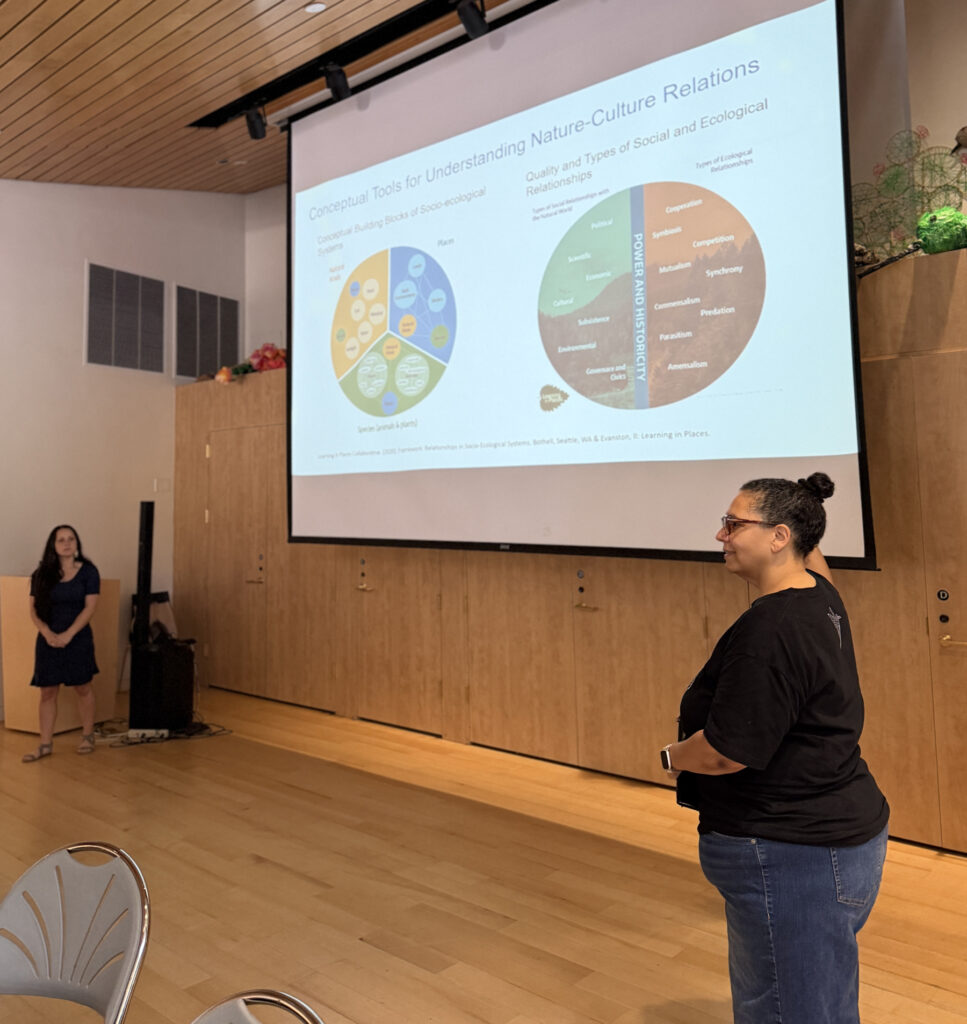
Ananda Marin, Ed&IS vice chair of graduate education and associate professor of education, and Nicole “Nikki” Barry (McDaid), assistant professor of education, presented their research discussing Indigenous perspectives on environmental justice, in the specific history of a place rather than as an abstract topic. They also shared the possibilities of designing inclusive teaching and learning spaces.
“Presenting at the EcoRise Summer Institute is a rich and fulfilling experience,” said Professor Barry. “Not only do I get to share information with teachers who are open-minded and thoughtful, but I learn from their innovative and inspiring ideas and pedagogies.”
In addition, Morris gave a tour of the UCLA Lab School campus, the curriculum of which represents UCLA innovation in environmental justice education with student-led projects such as a study on the effects of CO2 on indoor spaces, and the community impact of a greenhouse on campus.
“Visiting the UCLA Lab School was the highlight of my experience,” said a returning EcoRise Teacher Ambassador. “As I work on designing an outdoor learning space for our district, I gained invaluable insights and practical ideas I can immediately put into action.”
ASU hosted sessions on its research in the Walton Sustainability Teachers’ Academy (WSTA), housed in the Walton College of Global Futures. Participants experienced a preview of WSTA’s asynchronous teacher course, which gives K–12 educators classroom-ready games and activities developed by ASU faculty and scholars to integrate sustainability into their curriculum.
Elizabeth Harper and Abby Randall of EcoRise led a two-day design-thinking session using EcoRise’s Design Studio curriculum, where educators were provided with the same structured design process students would go through: identifying a real problem, understanding different stakeholders’ needs, generating and narrowing ideas, and pitching a solution.
A highlight of the session was the “Walking in Your Shoes” activity, where both Teacher Ambassadors and the Leadership Cohort worked through the same stakeholder viewpoint, that of a school administrator. Hearing directly from real administrators in the room let teachers compare their assumptions to the real thing, producing some genuine “aha” moments about what support actually looks like from and for school leaders.
Maria Mancia, assistant principal at Hamilton High School in Los Angeles, said that the Leadership Cohort “has given me more than professional learning—it has connected me to a national network of passionate educators and fellow school administrators who inspire and challenge one another.
“Through this experience, I’ve gained new perspectives on sustainability, climate resilience, and environmental justice while learning how to elevate student voice and leadership,” she said. “As an EcoRise Green School Leader, I look forward to cultivating joy, inspiring hope, and empowering students to create meaningful change in their schools and communities.”
“This institute has been a highlight of my … past two years and I leave here inspired and renewed in my why for teaching,” said another returning EcoRise Teacher Ambassador. “The EcoRise projects and showcases are some of the most impactful things I have ever done with students in my 13 years in education.”
Nine years ago, EcoRise brought together a handful of teachers for a few days each summer to talk about sustainability in the classroom. This year, UCLA and ASU helped shape that work, a sign that the effort to prepare teachers for climate education is scaling beyond any single school, district, or institution.
“This year’s program welcomed teachers and school leaders from across the country alongside ED&IS faculty, colleagues from Arizona State University, and other campus partners,” said Bang. “Together, we showcased the impactful work taking place across UCLA—from Mann UCLA Community School and our Lab School to the expertise of our faculty and interdisciplinary collaborators—while demonstrating how meaningful partnerships can connect research and practice, strengthen the bridge between higher education and P–12 schools, and ultimately create richer learning opportunities for students.”
For more information about EcoRise, visit the website.
Above: Noelani Ogasawara Morris, a primary level teacher at UCLA Lab School and EcoRise Teacher Ambassador, led a tour of UCLA Lab School for the Summer Institute. Photo by Paolo Cantos