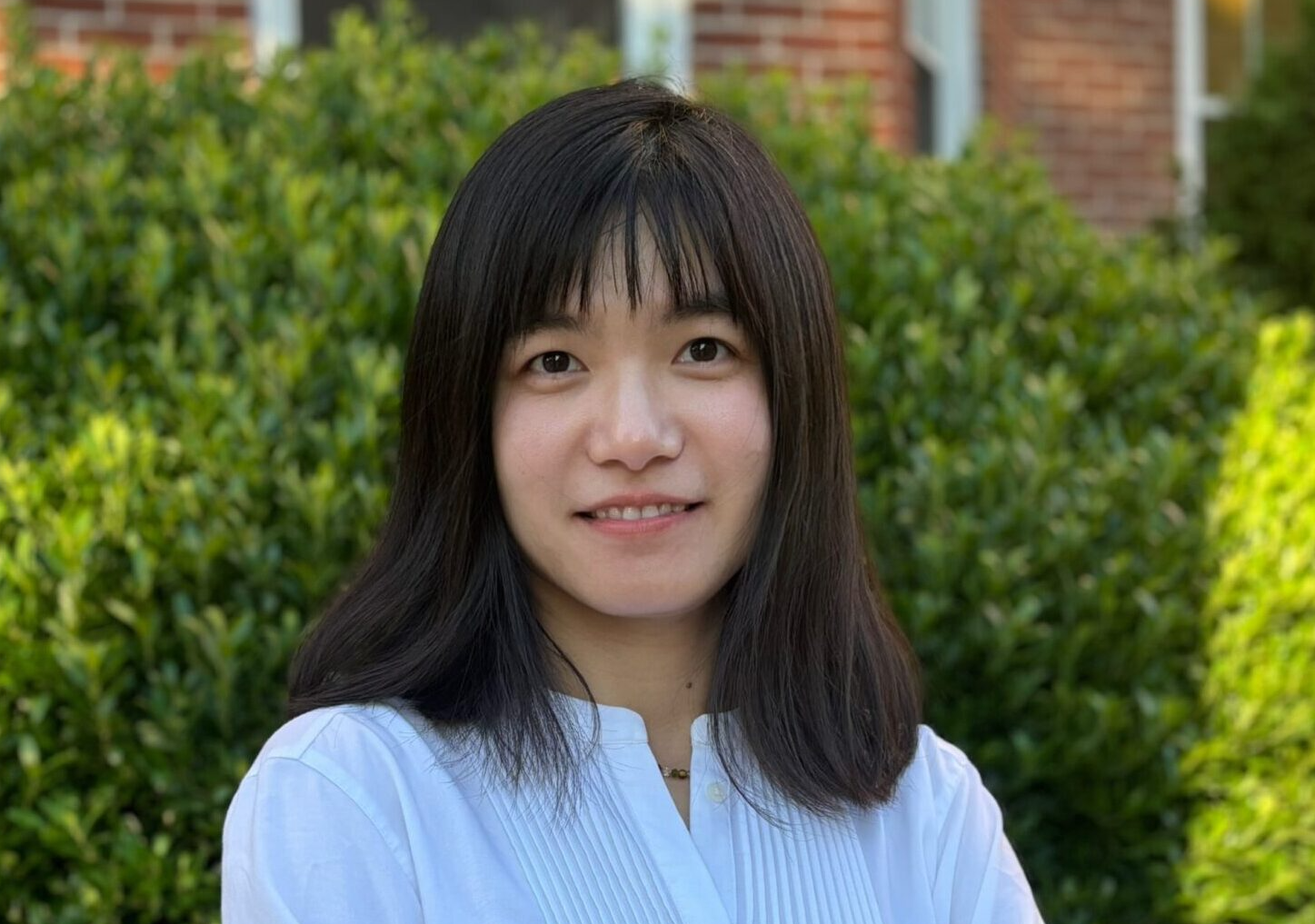
Assistant professor of education leads the Brain, Language, Education, and NeuroDiversity (BLEND) Lab at UCLA.
UCLA Assistant Professor of Education Jin Wang is one of six UCLA faculty members to receive the 2026-2027 Early Career Faculty Research Excellence Award from the University of California Office of the President. A one-time $50,000 allocation will support Wang’s proposed project, “Identifying the neural basis of phonological, semantic, and syntactic processing in 18-to-36-month-old awake toddlers: a passive-listening fMRI study.”
Launched in fall 2025, the UC’s Early Career Faculty Research Excellence Awards advance the enduring commitment to supporting the scholarship and creative activity of early career faculty across the ten-campus UC system.
“I’m very honored to get this award and recognition,” says Professor Wang. “This will help me to really pursue my brain imaging research on very young children’s brains for language processing and in the long run, we can incorporate a lot of the educational context … to inform educators and policy makers to better support young children’s development and language skills.”
Wang proposed to validate a child-friendly passive-listening, well-controlled linguistic task and a naturalistic functional magnetic resonance imaging (fMRI) in kindergarteners and awake toddlers in order to learn how different linguistic processes are presented in the very young brain.
“Toddlers can learn hundreds of [words] in a year, but then after they get older, they learn more slowly,” she notes. “Toddlerhood is of no doubt a critical language brain development period. However, due to the difficulty of scanning young children inside the MRI scanner with language task requirements, we don’t know about the brain in toddlerhood when their speech perception, vocabulary, and grammatical skills change so much.”
To fill such a gap, Wang’s research team will show the children auditory word pairs with animated cartoons to indicate whether the word pairs rhyme or not, are meaningfully related or not, and are grammatical or not, to study their brain responses. The children will be asked to lie in the scanner and listen passively. Additionally, the children will watch two movies while being scanned. The project is intended to test if a passive-listening, well-controlled linguistic task can capture relevant brain activity, similar to the literature on using linguistic tasks requiring a child’s response. In addition, the project is intended to test if large language models can be used to capture brain activity during movie-watching, similar to the well-controlled passive-listening linguistic tasks.
Professor Wang says that these tests on passive-listening linguistic tasks and naturalistic movie-watching will provide a reliable and easy-to-conduct paradigm for fMRI researchers to study the brains of very young children. Currently, her team piloted one adult participant and showed reasonable brain activation maps under different linguistic conditions, validating the passive-listening well-controlled linguistic task. Wang’s team is also in the process of exploring analytical pipelines for analyzing naturalistic movie watching.
“This is the very first step,” says Wang. “It won’t have an educational implication immediately, but it will serve as an approach or as a tool in the future to learn about brain development in very young children.”
“I also care about parent-to-child interaction and how much language input they get, and also early child education resources, especially for low-SES, marginalized populations, or bilingual populations,” she says. “Seeing how their brains are working as a response to these different environmental factors will be the long-term goal.”
Professor Wang says that it is “important to have developmental knowledge about children, cognitively, behavioral-wise, and brain-wise, so that educators know at which stage the brain has the most plasticity and is most sensitive to developing certain skills.” She says that language acquisition develops at the fastest pace in the first five years with heightened brain plasticity. Effective language interventions can only be created when we understand how different linguistic processes develop in the brain and what their influencing environmental factors are.
In previous years, Wang has extensively studied the neural development of various linguistic processes in children aged five to 10 years old, following them from kindergarten to their elementary school years. They found that kindergarteners rely more on the temporal lobe, a brain area associated with linguistic representational quality, but rely more on the frontal lobe, a brain area related to manipulations of sounds and meanings, later in development after age seven.
“This developmental transition from relying on the temporal to the frontal lobe for language specialization probably suggests that earlier education should focus more on high-quality language exposures to improve representational quality,” says Professor Wang, “whereas later education should practice more with language games, explicitly analyzing language structures to achieve goal-oriented language tasks effectively.”
Wang also studied the relationship between language and reading as well as the relationship between reading and math ability, due to the high rates of co-occurrence of dyslexia and dyscalculia. She found that phonological processing in the brain scaffolds word reading skills from kindergarten to 4th grade, and that additionally, reading deepens semantic associations, enhances phonological processing, and automatically activates the spelling patterns of spoken words in the brain.
“Those brain results support the use of phonological awareness tests for early screening of children at risk of developing later reading difficulty,” says Professor Wang. “Early screening in kindergarten is important because if we wait until a student is diagnosed with dyslexia at grade 2 or later to provide reading support, we may miss an intervention window that has a larger effect. However, our brain results also show the power of literacy education: learning to read reshapes our spoken language networks. Those changes remind us that we should not simply treat early screener performance, such as phonological awareness, as a determinant for reading difficulties. Children who have low phonological awareness entering kindergarten due to a lack of home literacy environments will likely gain skills quickly after being exposed to a rich literacy environment in school.”
Professor Wang says that phonological processing is also involved in number representation.
“While doing arithmetic, especially multiplication, you need to retrieve results based on the sound of the number and to map the number symbols to the meaning of it [and] to the sound of it,” she says. “It’s similar to the reading process at the very basic level of numerical recognition and numerical calculation, so that’s why people propose it could be a shared phonological processing that leads to both learning disabilities. This is still a debated area, where I have one ongoing paper exploring this.”
“Across my studies, language skills seem to serve as a foundation for various academic development, including reading and math. However, individual differences in various language skills already emerge when students enter kindergarten,” says Professor Wang. “Where do those individual differences come from? Does neural sensitivity to different linguistic processes emerge at different ages? Can we measure them reliably earlier when language acquisition develops the fastest? These questions drive my research attention to toddlerhood.”
Wang says that the most sensitive periods for neural development are very important for educators and parents to recognize in order to provide timely and targeted education.
“For policy makers in early childhood education, providing a stimulating and interactive language environment should be emphasized,” she says. “However, regarding what type of linguistic support at what age, we need more behavioral, brain, and intervention research to answer the specifics”.
“With the Early Career Research Excellence Award, I hope to fill the knowledge gap about toddlers’ language brain. With such brain knowledge, more educational guidance will come soon because we can identify environmental factors that drive those neural developments,” says Professor Wang.
Professor Wang joined the UCLA School of Education and Information Studies in 2024, and as of this year, has a joint appointment in the UCLA Department of Psychology, in the area of developmental psychology. She established and serves as director of the Brain, Language, Education, and NeuroDiversity (BLEND) Lab at UCLA, and her research employs a combination of behavioral assessments and neuroimaging techniques (fMRI, MRI, and DTI), using both cross-sectional and longitudinal designs, to examine individual differences in the development of the linguistic brain and its influence on academic achievement.
Wang’s research goal is to construct a neurocognitive model that interprets the underlying mechanisms of language (i.e., phonological, semantic, and syntactic) development during children’s first ten years of life and how these various linguistic processes are associated with reading and math skills.