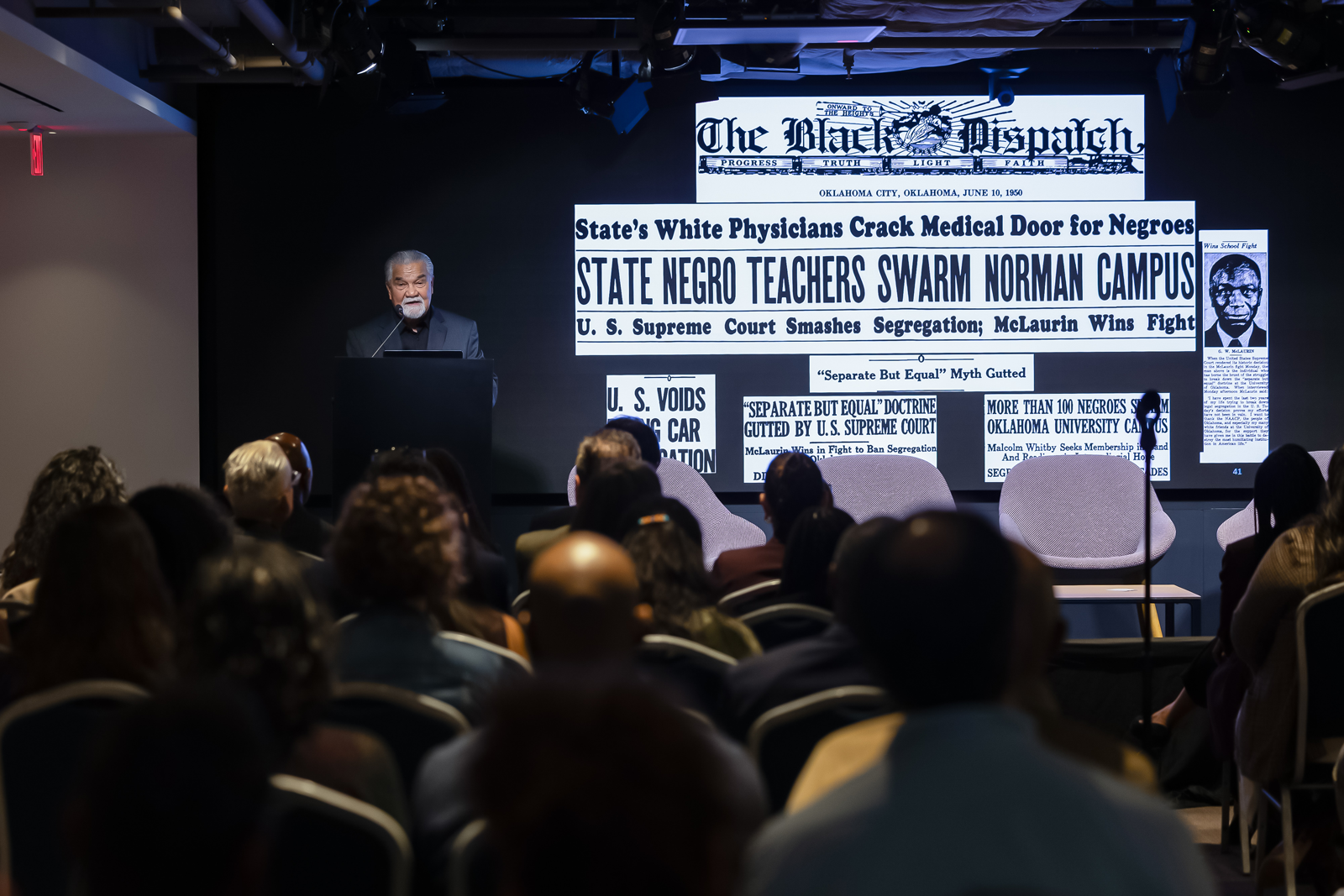
Distinguished Professor of Education discusses historic George W. McLaurin case, examines how access and admission do not necessarily mean equality.
Daniel G. Solórzano, UCLA Distinguished Professor of Social Science and Comparative Education, delivered the 2026 Brown Lecture in Education Research, presented by the American Educational Research Association (AERA) on Nov. 5. The event was held in-person at AERA’s headquarters in Washington D.C and livestreamed; to view the lecture, visit YouTube.
Professor Solórzano presented, “Admitted but Not Equal: What George McLaurin’s Story Tells Us About Race, Racism, and Education in 1948 and Today,” examining the story of George W. McLaurin, a veteran educator who, at 54 years old, became the first Black student admitted to the University of Oklahoma in 1948. Although permitted to enroll in the university’s doctoral program in educational administration, McLaurin was segregated from his white classmates, in the classroom, library, cafeteria, and other spaces across campus. Drawing on archival research and the scholarship of pioneering legal scholar Derrick Bell, Solórzano delineated the landmark 1950 Supreme Court case McLaurin v. Oklahoma State Regents, raising timely questions about racial inequality and equal opportunity and assessed how patterns of exclusion can persist within educational institutions even after formal legal barriers have been removed.
Professor Solórzano was introduced by Tabbye M. Chavous, executive director of AERA, and Jerome E. Morris, the E. Desmond Lee Endowed Professor of Urban Education at the University of Missouri-St. Louis. A discussion forum with Professor Solórzano followed his lecture, moderated by Lia Epperson, professor of law, American University, with commentators Jessie Brown, executive vice president of the American Council on Education; and Erin Dunlop Velez, vice president of research for the Institute for Higher Education Policy.
Professor Solórzano recognized his UCLA colleagues, Professors Sylvia Hurtado, AERA President-Elect and UCLA Distinguished Professor, and Walter Allen, the Allan Murray Cartter Professor of Higher Education and UCLA Distinguished Professor, for their respective work in campus racial climate.
“It’s one thing to be on a campus, but it’s how you’re treated once you’re on that campus that is something I think we have to continue to talk about,” said Solórzano. He noted the disparities in the ratio of Latino faculty to Latino students, saying that “White students see themselves in the front of the classroom. They may see themselves in the research that’s shared in those classrooms. Latino students less likely, Black students less likely, Native American students less likely.
“How we serve our Latino students, our Black students, our students of color at our institutions … I think those are the kind of questions that we need to honestly engage with,” Solórzano said.
In his lecture, Professor Solórzano discussed interest convergence, the theory that advances in equity for marginalized groups only happen when they align with the interests of the political, economic, or social interests of the white majority. In the panel discussion, he said that the recent midterm election results do not mean that diversity, equity, and inclusion are ensured going forward.
“I really want to look at South Texas, because they had moved so far over to support Donald Trump in 2024 and they just moved completely back,” said Solórzano. “And I want to know from exit polls, how [and why] did they… what is the rationale? I think … researchers, political scientists are going to go in there now and try to answer that question. And I think that for me, that’s important.”
Circling back to his lecture’s theme of student inequality despite admission, Professor Solórzano referenced the 2020 goal of the California Community College system to conduct a racial equity audit, a goal that according to Solórzano was “waited out” until the the “racial reckoning” in the wake of the murder of George Floyd had subsided.
“I have former students who are presidents of community colleges [and] teaching at community colleges and we have these conversations,” said Solórzano. “Community colleges, at least from my perspective, are some of the most important places, educational places in the country, period.

“In California, eight out of every 10 Latino students who go on to post-secondary education start at the community college,” he said. “Fifteen out of every hundred will go to the California State University system. Only five of that hundred will go into a UC campus.”
Professor Solórzano said that despite these low transfer numbers are due to the community college serving as a gatekeeper, hindering students of color from entering California’s two public university systems due to “structural conditions,” such as
“The name of the game is not the UC campus… probably not the CSU. The name of the game is a community college that’s where it’s happening, and what we know unfortunately, that even those students, who when they fill out that application for admission, say that they aspire to go down to a four-year institution a very small percentage actually do, because of all of the different structural conditions that exist within those institutions, including math requirements that leave students of color out.
“I looked at the data, five, six, seven years ago,” said Solórzano. It was those [developmental] math courses [for which] students would take an exam, place at a certain math level, and then try to get classes that led to transfer level math.
“We lost students. thousands and thousands of students who aspired to go on to four-year institutions – that developmental math sequence just killed their aspirations,” he said.
Solórzano is the director of the Center for Critical Race Studies in Education at UCLA and serves on the faculty of UCLA Chicana/o and Central American Studies. His teaching and research interests include critical race theory in education; racial microaggressions; racial microaffirmations; and critical race spatial analysis. Professor Solórzano has authored more than 100 research articles, book chapters, and books on issues related to educational access and equity for underrepresented student populations and communities in the United States.
In 2007, Professor Solórzano received the UCLA Distinguished Teaching Award. In 2012, he was awarded the Critical Race Studies in Education Association Derrick A. Bell Legacy Award and was elected an AERA Fellow in 2014. In 2020, Solórzano was elected to the National Academy of Education and received the Distinguished Alumni Award from the Claremont Graduate University.
To view “Admitted but Not Equal: What George McLaurin’s Story Tells Us About Race, Racism, and Education in 1948 and Today,” the 2026 AERA Brown Lecture in Education Research by Professor Solórzano, visit YouTube.
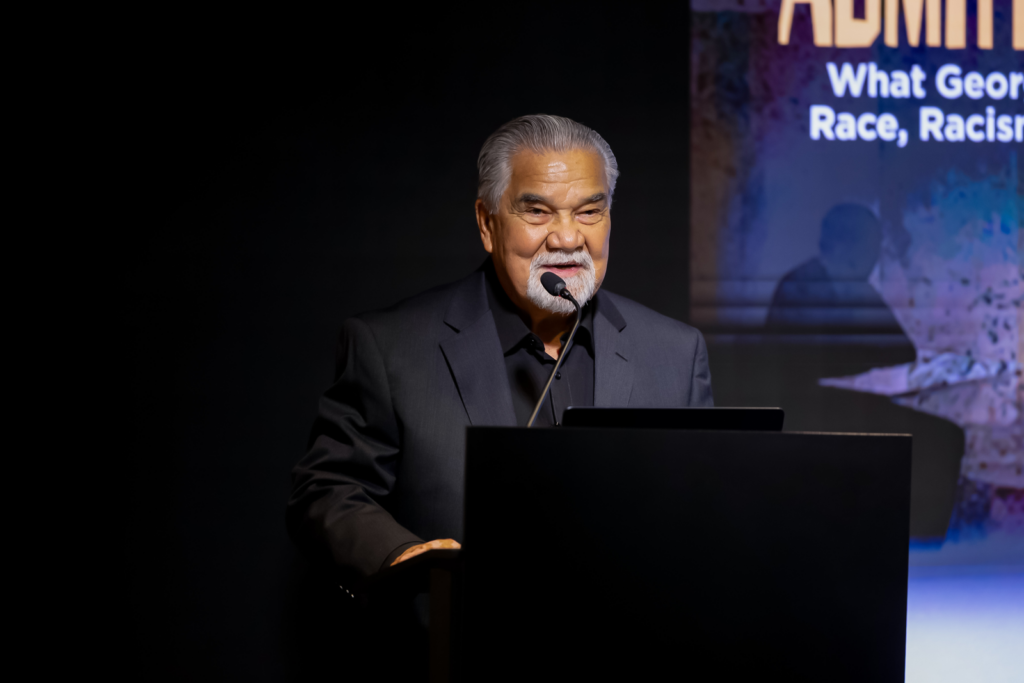
Above: UCLA Distinguished Professor of Education Daniel Solórzano presented, the 2026 Brown Lecture in education research, titled, “Admitted but Not Equal: What George McLaurin’s Story Tells Us About Race, Racism, and Education in 1948 and Today.” Solórzano, who is also a faculty member in the UCLA Department of Chicana/o and Central American Studies, examined the story of George W. McLaurin, a veteran educator who, at 54 years old, became the first Black student admitted to the University of Oklahoma in 1948 but had to endure segregation from his white classmates in spaces across campus. (Courtesy of AERA)