Iconic LAUSD school celebrates its roots as a pioneering institution of public education in partnership with the University.
An anchor of its South Los Angeles neighborhood, Mann UCLA Community School celebrated its centennial on April 10 with a visit from NBA legend Kareem Abdul-Jabbar, a mural festival led by Branded Arts, and reminiscences of Mann alumni whose successes inspire the next generation of students.
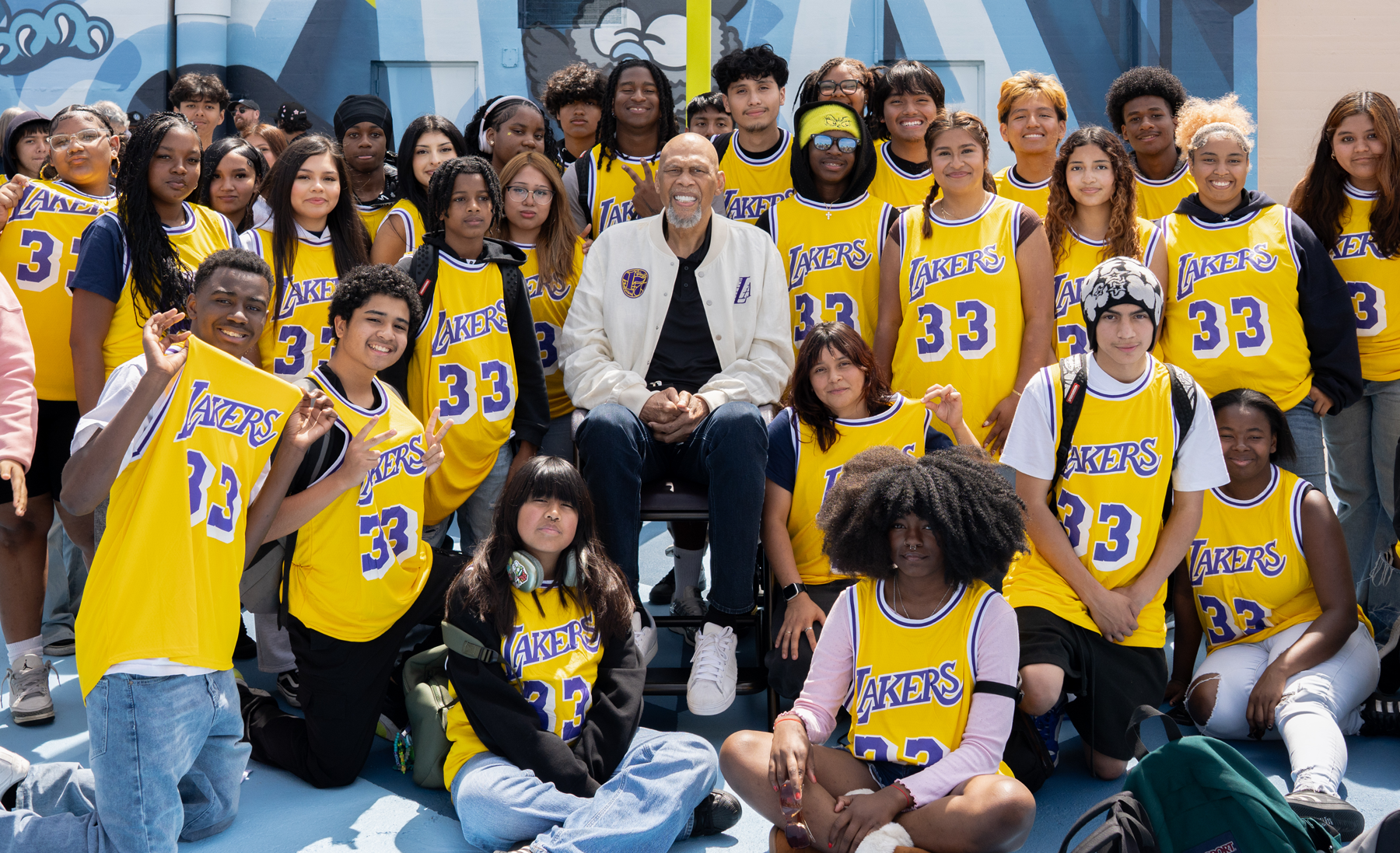
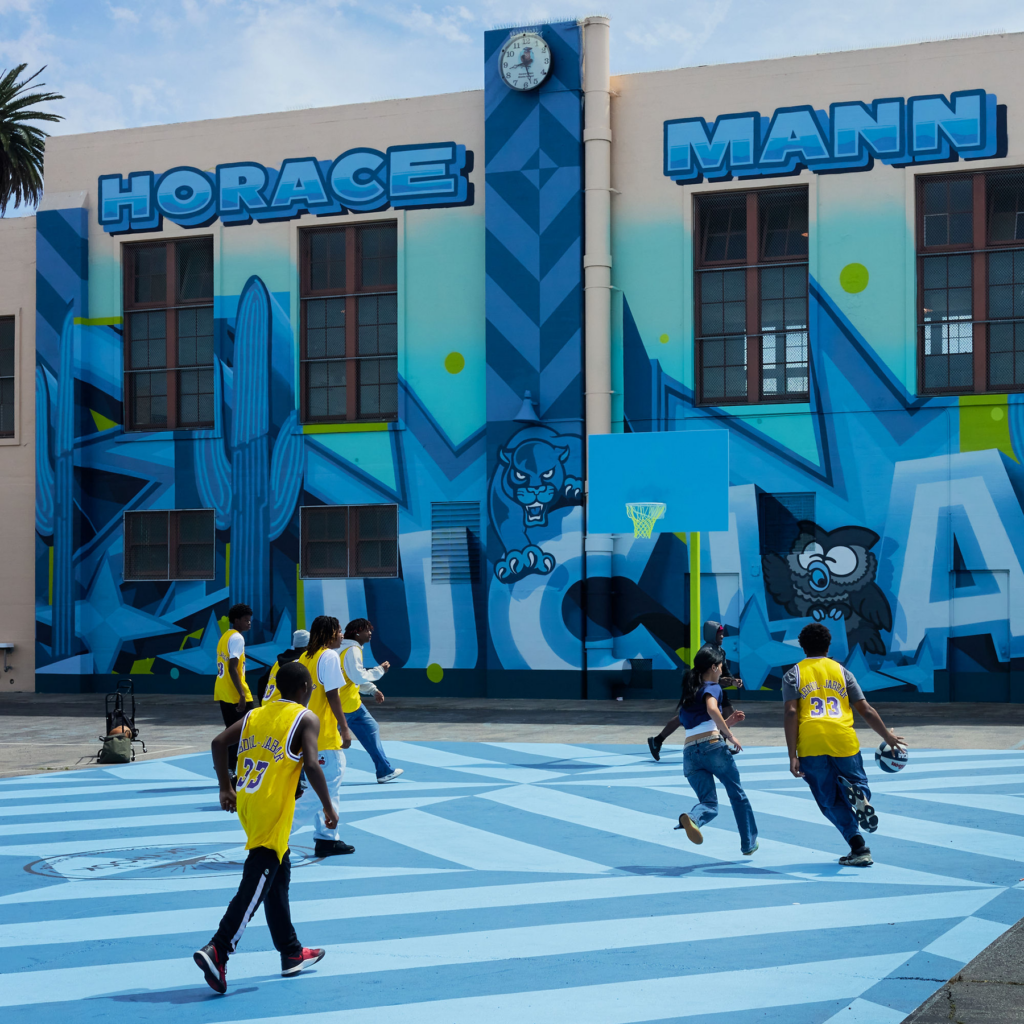
The day’s festivities began with the dedication of the Skyhook Court, designed and painted by artist Travis Young, a muralist with Branded Arts, and named for Abdul-Jabbar’s nonprofit, the Skyhook Foundation, which is dedicated to providing outdoor Science, Technology, Engineering, Arts and Mathmatics (STEAM) experiences for students. Earlier that morning, Mann UCLA students were given special edition LA Lakers jerseys, emblazoned with Abdul-Jabbar’s number “33.” On the Skyhook Court, they received an inspiring message from one of UCLA’s most renowned Bruins.
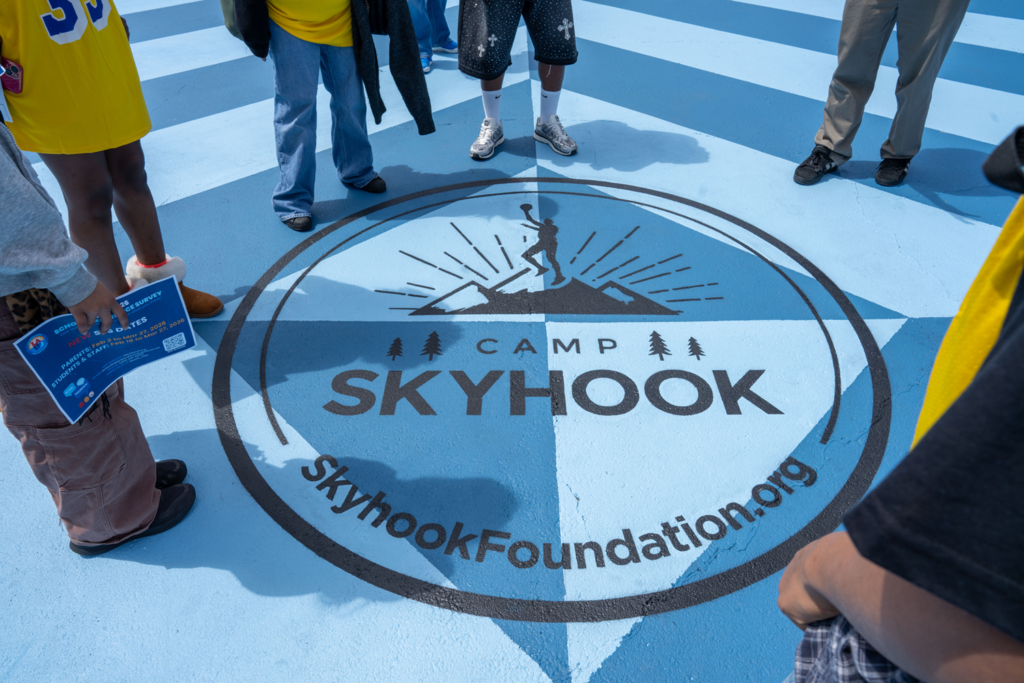
“Sitting here today is both humbling and inspiring,” said Abdul-Jabbar on the court, surrounded by students. “To be honored in a place dedicated to learning, community, and creativity means a lot to me.
“Education has always been close to my heart because it shapes how we understand the world and our place in it,” he said. “When we talk about education, we’re really talking about fairness, access, and opportunity. We’re talking about making sure every young person has the tools they need to succeed, not just in school but in life.”
Abdul-Jabbar noted that the newly decorated basketball court embodied “STEAM brought to life. It’s where imagination meets structure; where art meets science; and where young minds can begin to see connections between what they learn and what they can become.
“This is what I want the students to know: this space is yours,” said Abdul-Jabbar. “Let it inspire you, let it challenge you. Let it remind you that your potential is limitless. And remember, education is the real skyhook – it lifts young people beyond what they ever thought was possible.”
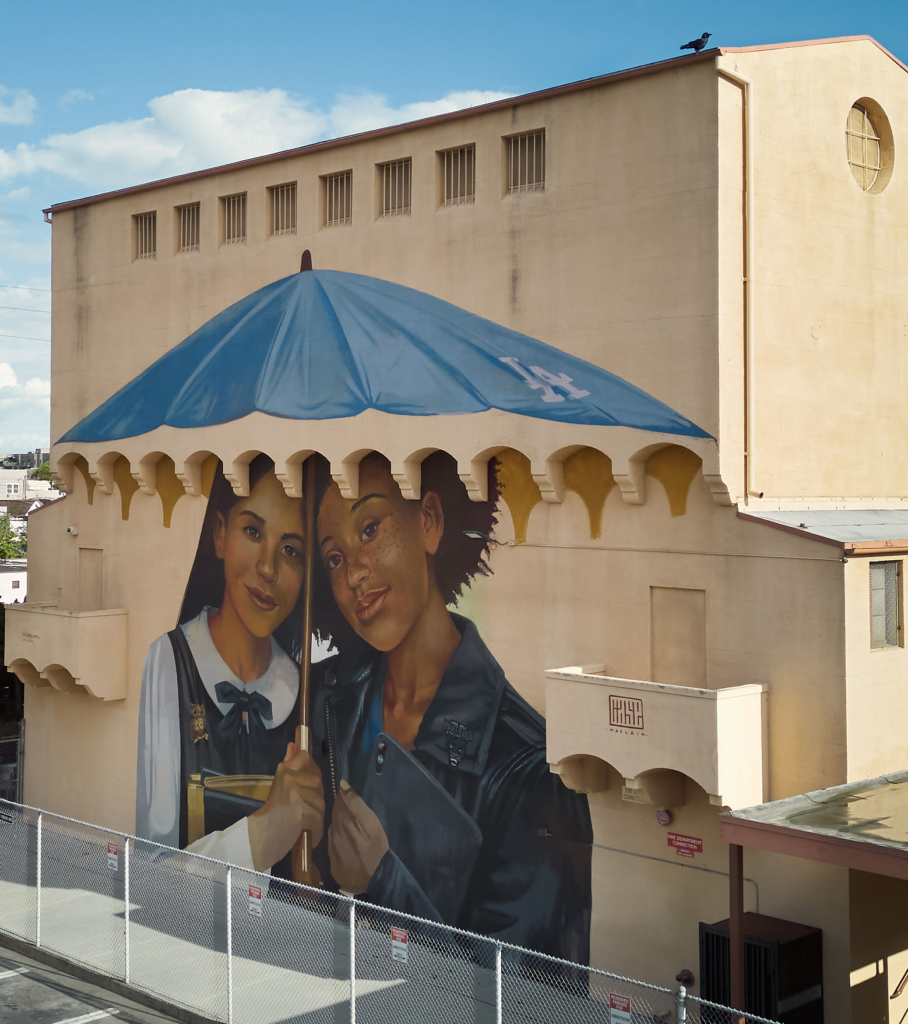
A nonprofit dedicated to the creation of large-scale public art that reflects the communities where they are created, Branded Arts focuses on transforming schools into environments that connect young people to the creative economy. Following weeks of collaboration with UCLA Mann students, faculty, and staff, eight murals were painted across the campus by internationally recognized and Los Angeles–based artists, including Brek, Case Maclaim, Enkone, HERA, Matthew Grabelsky, MAYD, Mister Alek, and Tochtlita (Melissa Govea).
In preparation for the centennial celebration, the artists engaged students in contributing ideas for what the murals would depict, helping to paint them, and workshops and conversations that gave students firsthand exposure to how large-scale public art is conceived and executed.
“We had a robust process to do this project,” said Warren Brand, founder of Branded Arts. “We were able to select the best, most impactful locations at the school to put art, and I hope this opens doors for more artists and organizations to get involved with the school.”
Later in the day, the celebration moved into the school’s auditorium, where English teacher Greg Amelio emceed a panel of Horace Mann alumni and congratulatory remarks from Mann Principal Maria Cristina Phillips; UCLA Chancellor Julio Frenk; Executive Vice Chancellor and Provost Darnell Hunt; Dean Christina Christie of the UCLA School of Education and Information Studies; and representatives of local and county government. Mann students Beautiful Brown, Abraham May, Myheir McNeal, and Warenn Trujeque also participated in the program; Trujeque has been accepted to and will attend UCLA in the fall.
Members of the alumni panel included Leon Anderson (’03), actor, playwright and author; Julia Brown (’92), director, UCLA Government & Community Relations; Bryan Cantero (’12), PhD candidate and adjunct faculty in Chicano studies, CSU Dominguez Hills; Youlanda Copeland-Morgan (’73), UCLA retired vice provost of enrollment management; Jamaica Murphy (’99), PhD candidate at the Harvard School of Education; and Dr. Jewett L. Walker, Jr., senior advisory and community liaison for LAUSD Board Member Hendy Newbill.
In a video message, Chancellor Frenk congratulated UCLA Mann for the “remarkable milestone” of 100 years and its legacy of “learning, perseverance, and belief in what education can make possible.
“Community partnerships go to the heart of UCLA’s mission,” he said. “They expand opportunity, strengthen connection, and help students thrive, not just in school but in life.
“Mann UCLA Community School stands out because it is built on connection – connection between UCLA and LAUSD; between families, educators, and neighbors – all grounded in a shared commitment to students in South Los Angeles and to the future,” said Frenk. “This school shows what can happen when academic rigor and college-readiness come together in a supported, community-rooted environment.”
Karen Hunter Quartz, director of the UCLA Center for Community Schooling, recalled the beginnings of the partnership between Horace Mann Middle School and UCLA, which began officially in 2017, after the school offered a summer high school prep academy in collaboration with the University the prior year.
Quartz thanked the numerous partners from across UCLA that have collaborated with the Mann community, including UCLA students serving as BruinCorps tutors and counselors at UniCamp; student teachers from the UCLA Teacher Education Program; teaching artists from the Hammer Museum; UCLA Medicine’s Wellness Collaborative for Research & Education Activities to Transform & Empower (WeCREATE); and BRIDGE mentors who prepare Mann students for college.
“Ten years ago, the Mann faculty welcomed us into their community,” said Quartz. “Since then, UCLA partners have contributed more than 250,000 hours as student teachers, tutors, interns, researchers, teaching artists, camp counselors, and much more. What a joy to celebrate the centennial of this historic neighborhood school together!”
Located in South Los Angeles, Horace Mann Junior High School opened in 1926 and witnessed a century of social change, shaped by racially restrictive housing covenants of the 1930s and the 1950s post-war employment boom. Over the past two decades, enrollment steadily decreased alongside the rapid expansion of charter schools in the area. Responding to the national increase of school closures in Black and Brown neighborhoods, UCLA partnered with Mann in 2016 to ensure its future as an excellent public school and center of the community.
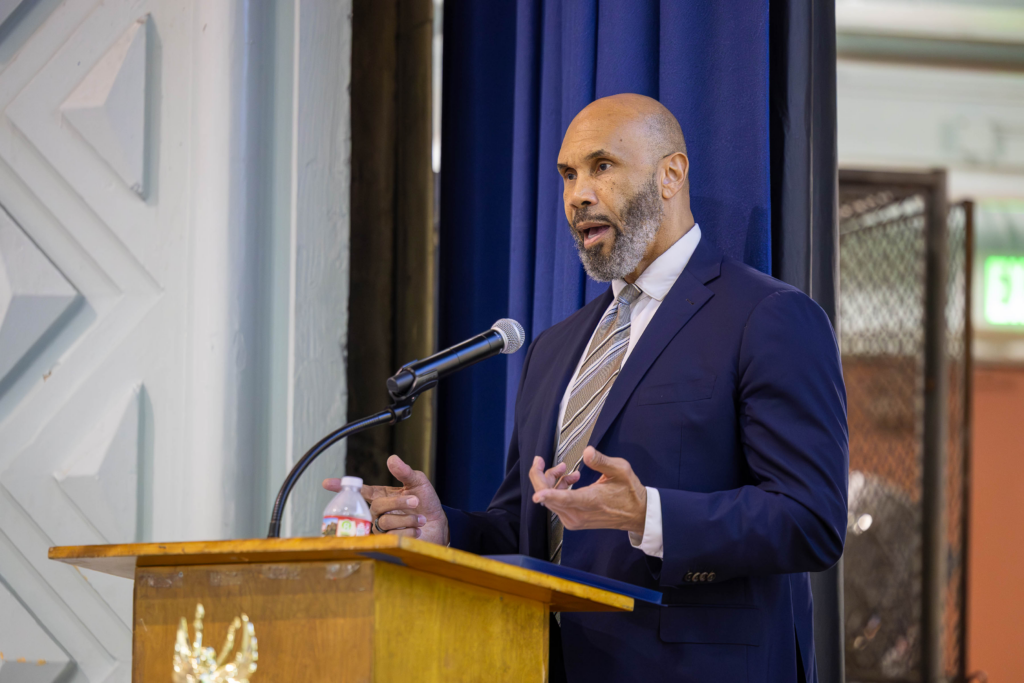
Since then, enrollment has steadily grown as the middle school expanded to incorporate grades 9-12 and was renamed Horace Mann UCLA Community School. In 2021, the first cohort of seniors graduated, all with postsecondary college-going plans. Today, Mann UCLA has a 100% graduation rate, with 16% of this year’s graduating seniors heading to UCLA.
“A 100% graduation rate is extraordinary,” said Executive Vice Chancellor Hunt. “But even more powerful is how it was achieved: through deep relationships, community engagement, and a belief that every young person can succeed. UCLA’s work in community schooling shows that real transformation happens when you see schools as ecosystems, where everyone comes together to disrupt inequities and support the whole child. Mann provides continuity, academic rigor, shared leadership, and wraparound support for students and families. The results speak volumes.
“Today, we celebrate the people who make this place so special – the educators, families, neighbors, supporters, alumni, and students,” said Hunt. “You are the heart of Mann. On behalf of UCLA, we are proud to be on this journey with you. Congratulations on your centennial, here’s to your past, your present, and your promising future.”
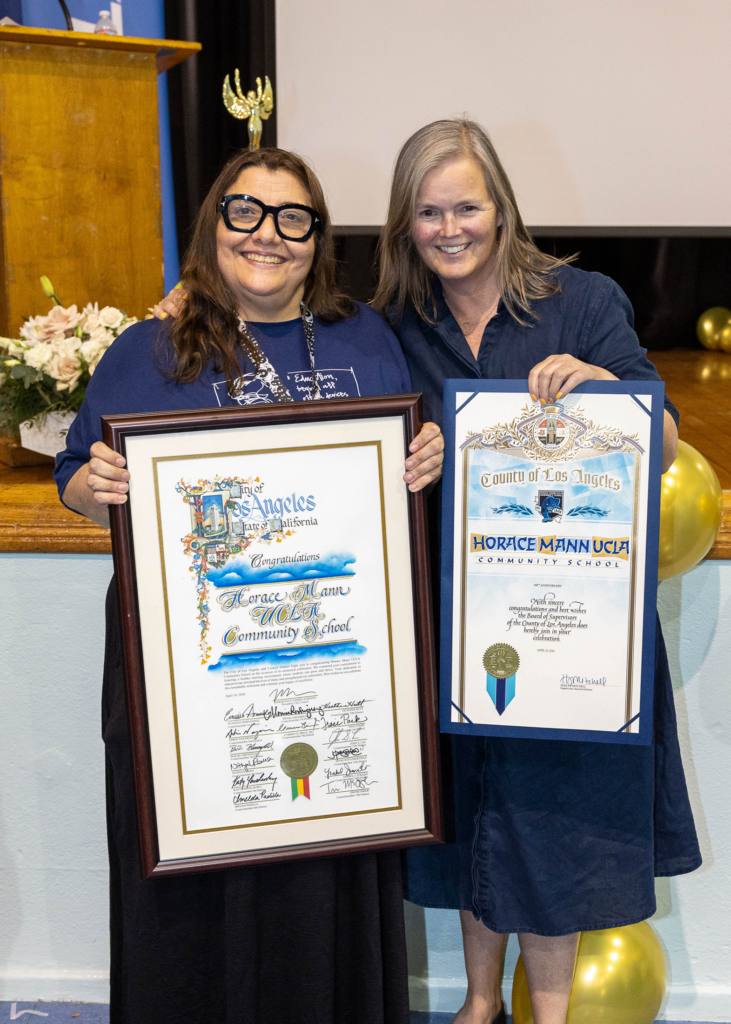
Vernell Brown, Mann alumnus and lead community intervention worker for the office of LA City Council President Marqueece Harris-Dawson, recognized teachers who had served at Mann for 20 years. Those honored were Ngozi Afonta, Greg Amelio, Akili Carter, Frederick Clark, Floydette Gibson, Elizabeth Hicks, Miriam Martinez, Paulette Shelley, Gladys Storey, Clifford Walker, and Janice Yorksmith, who received certificates from the County of Los Angeles. In addition, Quartz and Principal Phillips presented a banner to be displayed outside the school, designating Mann as a UCLA Community Partner, and accepted a proclamation from the City of Los Angeles and Council District 8, signed by Harris-Dawson and members of the City Council.
Copeland-Morgan fondly remembered the faculty at Mann and how they enhanced her education.
“We called them teachers, but they did more than teach,” she said. “They took care of us, they looked out for us. They saw potential in us that we did not see. They were available to us before school, after school. They made classrooms interesting for us. I loved Shakespeare after graduating from here and that influenced the courses I took when I got to Crenshaw High School.”
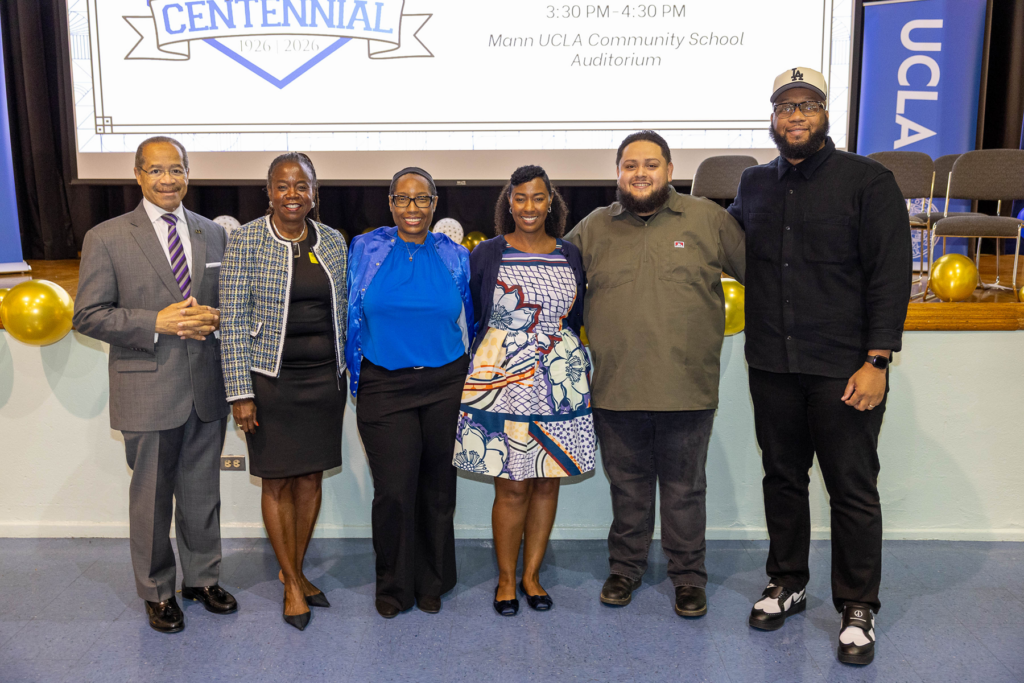
Brown said that her time at Mann during her formative years instilled “wanting to pursue greatness” in her.
“I was very active in groups and clubs, in particular, the Academic Pentathlon,” Brown said, wearing the blue satin jacket with the competition’s emblem on it. “I was able to see the importance of teamwork and working with people who shared the same common goals and the same drive to win it.”
Anderson said that Mann “was the place that helped structure… all the things that I do today.
“When I was here, sixth grade to eighth grade… those are difficult years for adolescents,” he said. Mann provided structure, discipline, and leadership. You had to be a leader not a follower, in some cases, while going here.
“I’m not going to say this because he’s standing here – but I always had a passion for writing in elementary and Mr. Amelio just happened to be my English teacher, and he helped form and bring ideas to life. And that’s what I use in my everyday life, with my organization and my company.”
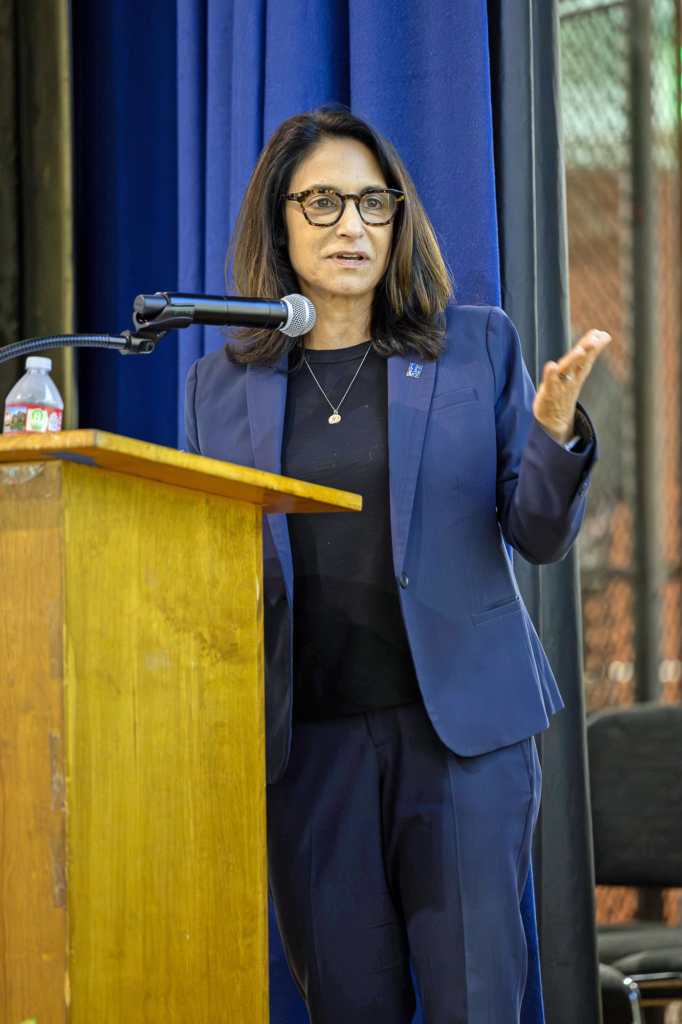
Murphy recalled being supported by her great-aunt who raised her when she attended Mann, and by the local community that “fills the gaps” for students.
“Students come in with different needs,” she said. “That’s where partnership and understanding your community’s resources comes in. I think that having a community school here means that all students are able to have access to the everyday needs to thrive…. especially when they are coming from under-resourced homes or homes where parents or family members are unable to provide them with what they need in different domains.
“The psychological safety that you are giving kids, where they feel comfortable coming up to … adults in the school community means that they feel safe, saying, ‘I’m afraid,’ ‘I need something,’ or, ‘I’m not okay,’ hasn’t always been the case and I see that’s the case now,” said Murphy.
Principal Phillips noted that the school’s namesake was significantly responsible for UCLA’s genesis as a teacher training school and the serendipity of the partnership between the University and Mann.
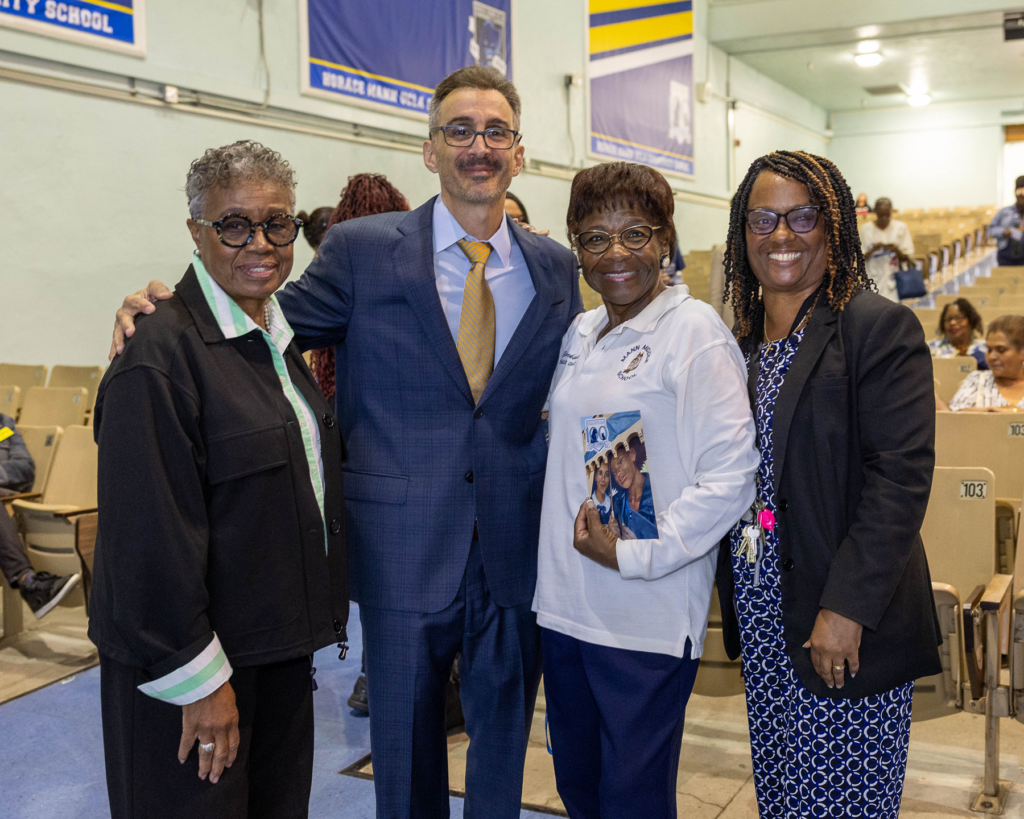
“Horace Mann was the father of public education in the United States and it was because of [his] push for public education that state normal schools to train teachers were created,” Phillips said. “It is really wonderful that Horace Mann Middle School partnered with UCLA … because UCLA wouldn’t exist without Horace Mann.”
Phillips said that the partnership has resulted in “a lot of momentum that is leading to the success of our students.”
“We believe that kids can reach amazing heights here at our school,” she said. “This year, we have our first QuestBridge Scholar, who got a free ride to USC. This year, two of our senior class are part of the student council of our board member for [LAUSD’s Board] District One. I am very proud to be the principal of a school named after the guy who created the public school education system in the United States, which is everything about our mission: to bring kids to the point where they have choices to enter the gates of the upper levels of society, with education to back them up.”
Dean Christie saluted Mann’s history as a pioneering institution, and said that the partnership with UCLA is part of a national effort “grounded in the the conviction that universities have both an obligation and an opportunity to engage in the communities they call home.”
“Mann is thriving, not as a charter, not as a cautionary tale [but] as a public school, still the cornerstone of this community, still doing pioneering work,” said Christie. “The question was whether a research university could be an authentic partner in that effort, not directing from the outside but working alongside the educators, families, and students who had never left.
“Students are embarking on inspiring college and career journeys that reflect the full strength of their hopes for the future,” she said. “But none of that happened because UCLA showed up. It happened because the people here showed up every day, and UCLA was fortunate enough to be part of the effort.”
Dean Christie highlighted the “powerful context for learning” on both sides of the Mann-UCLA partnership.
“There is no brief visit, there are no symbolic gestures,” she said. “There are sustained engagements that shape everyone involved. I hear from UCLA colleagues regularly about what they have learned here that they could have never learned anywhere else. That is how we know this is working.”
Christie said that the centennial of the historic school arrived “at a moment of enormous flux in public education.”
“Public schools are not incidental to democracy. They are the institution through which democratic societies make their most concrete commitments to equality and shared civic life. They are where we work out, generation after generation, what it means to live and learn together.
“To the students: what you are doing has consequence, and we thank you for it. To our teachers: what you can measure in graduation rates and test scores only begins to capture what you actually do at this school every day, and we thank you for it. To the families: the trust you extend every morning when you send your students here is the foundation on which everything else rests, and we thank you for it. And to the partners and elected officials here today, this is what public education looks like when it receives the sustained attention and investment it deserves. Thank you for being part of it.”
Above: NBA legend and renowned Bruin Kareem Abdul-Jabbar visited Mann UCLA Community School during the celebration of the South L.A. school’s centennial, and dedicated the Skyhook Foundation basketball court, named for his nonprofit that provides outdoor STEAM experiences for students. Photo by David Esquivel/UCLA