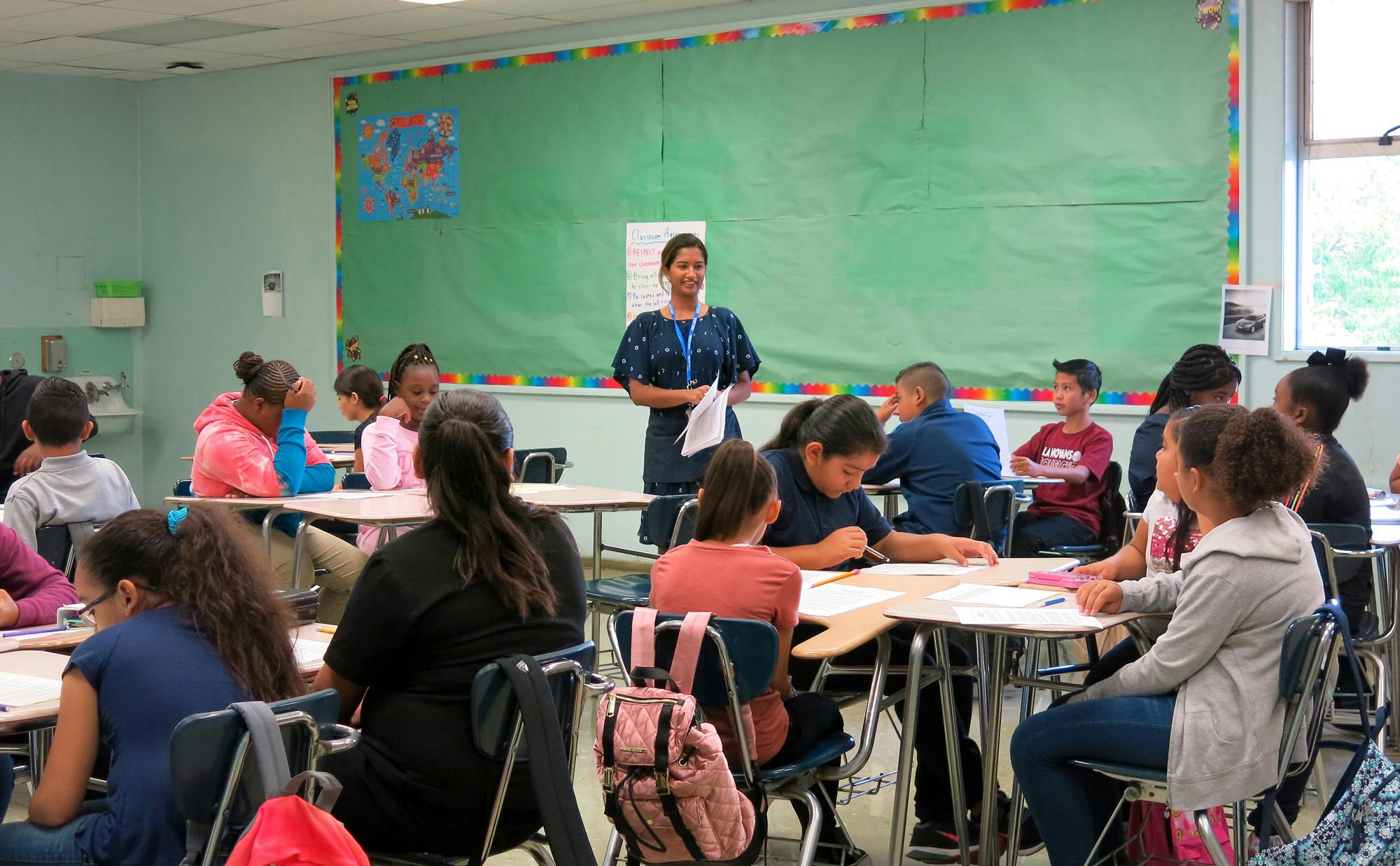
A new research brief from the UCLA Center for the Transformation of Schools illuminates evolving trends in teacher educational attainment in California from SY 2019-20 to SY 2023-24.
The brief, “Six Years of Change: What Statewide Trends Reveal About California’s Teaching Workforce,” analyzes statewide teacher data from the California Department of Education (CDE), providing the most comprehensive view of California’s teaching workforce since 2019. The dataset reveals significant post-pandemic shifts in teacher experience levels, workforce composition, credentialing, and subject-area staffing. The state also saw notable increases in Latine and Asian teachers, while the number of white and Black teachers declined slightly. Gender representation among teachers remains largely unchanged with female teachers making up nearly three-quarters (72.73% in SY 2023-24) of the teaching workforce.
Importantly, while the data reflect the persistence of traditional credentialing pathways, it also makes clear a growing shift towards more accessible, integrated teacher preparation programs. According to the CDE data, there has been an increasing trend of percentage of teachers with bachelor’s degrees from 25.67% to 28.34% and a decreasing trend of the percentage of teachers with bachelor’s plus degrees from 29.81% to 25.72%.
“The data are essentially showing us that more teachers are taking advantage of newly introduced integrated undergraduate programs or blended teacher education programs to obtain their teaching credentials before completing a traditional post-baccalaureate teacher credentialing program,” said Grace Kim a research analyst at the Center and the lead author of the research brief.
The research brief also details important increases in the number of Latine and Asian teachers in California’s Teaching workforce. In contrast, the data shows concerning declines in Black female teachers during the same time.
“It’s a real win to see these increases in the number Latine and Asian teachers,” adds Kim. “However, the trend in the decline of Black female teachers raises concerns about why they are not experiencing the same gains and questions about what changes are needed to improve recruitment and support of Black teachers,” Kim adds.
“These findings illuminate both the resilience and fragility of California’s educator pipeline and highlight both opportunities and persistent challenges in the recruitment and retention of teachers,” said Stanley Johnson, senior project scientist at the Center of the Transformation of Schools and a co-author of the research brief.
“Importantly, given the rising number of inexperienced teachers California should prioritize policies and funding that support teacher retention, mentorship, and professional growth for early-career educators. To build a sustainable and equitable teacher workforce, state and local leaders must take coordinated action to strengthen pathways into the teaching profession, especially for educators of color and those entering through alternative routes.”
Key findings of the research brief include:
The number of experienced teachers decreased. * The number of experienced teachers decreased from the peak in SY 2020-21 of 254,122 to 247,833 in SY 2023-24, and the number of first-year teachers increased from 17,248 in SY 2019-20 to 19,495 in SY 2023-24. (* Newly released data from CDE for the 2024-25 school year published after the completion of this analysis reports an increase in the number of experienced teachers. The new data shows 88.3 percent of K–12 teachers in California in 2024–25 are considered experienced representing an increase of 4,929 teachers since the 2023–24 school year.)
The number and percentage of Latine and Asian teachers increased. * The number of Latine teachers increased from 61,518 (21.81% of the workforce) in SY 2019-20 to 73,440 (25.69%) in SY 2023-24. The number of Asian teachers increased from 16,698 (5.92% of the workforce) in SY 2019-220 to 17,877 (6.25%) in SY 2023-24. (*Newly released data from CDE reports the numbers of Hispanic or Latino teachers continued to climb during school year 2024–25 — rising an additional 2.1 percent to 74,974.)
The number and percentage of white teachers decreased. The number of White teachers decreased from 170,929 (60.61% of the workforce) in SY 2019-20 to 158,064 (55.29%) in SY 2023-24.
The number and percentage of Black teachers decreased. The number of Black teachers decreased from 10,376 (3.68% of the workforce) in SY 2019-20 to 10,223 (3.58%) in SY 2023-24.
There was an increase in the percentage of inexperienced teachers for critical subjects such as English Language Arts, Mathematics, and Science. The percentage of inexperienced English Language Arts teachers increased from 10.89% in SY 2020-2021 to 14.41% in SY 2022-23. Inexperienced Mathematics teachers increased from 11.16% in SY 2020-2021 to 13.98% in SY 2022-23. Inexperienced Science teachers increased from 12.39% in SY 2020-2021 to 14.39% in SY 2022-23.
The percentage of undercredentialed teachers increased for critical subjects such as English Language Arts, Mathematics, and Science. English Language Arts teachers who are not fully credentialed increased from 3.56% in SY 2020-2021 to 5.67% in SY 2022-23. Mathematics teachers who are not fully credentialed increased from 4.16% in SY 2020-21 to 6.36% in SY 2022-23. Science teachers who are not fully credentialed increased from 4.06% in SY 2020-21 to 5.98% in SY 2022-23.
A master’s degree continued to be the most common level of educational attainment among teachers. Notably, the share of educators holding a bachelor’s degree surpassed those with a bachelor’s plus a teaching credential, making it the second most prevalent level of attainment among practicing teachers. The percentage of teachers with master’s degrees remained the highest at 31.32% in 2023-24. The percentage of teachers with bachelor’s degrees increased from 25.67% in SY 2019-20 to 28.34% in SY 2023-24. The percentage of teachers with bachelor’s plus decreased from 29.81% in SY 2019-20 to 25.72% in SY 2023-24.
The gender composition of the teacher workforce remains stagnant. Male teacher percentage remains relatively stagnant, at 27.45% in SY 2019-20 and 27.26% in SY 2023-24. Female teacher percentage also remains relatively stagnant, at 72.47% in SY 2019-20 and 72.73% in SY 2023-24.
To assist policymakers and educators, the research brief also offers recommendations to address challenges in teacher recruitment, diversity, preparation, retention, and quality designed to help state and district strengthen the educator pipeline, ensure equitable representation, and support the long-term sustainability of California’s teaching workforce. A partial list includes:
- Establish statewide metrics and goals for a capable, sustainable, and diverse teacher workforce.
- Strengthen teacher mentorship to address the rising number of inexperienced teachers’ post-COVID.
- Expand and sustain recruitment pathways for teachers of color.
The full research brief with complete data and analysis and full list of recommendations is available on the Center for the Transformation of Schools website.