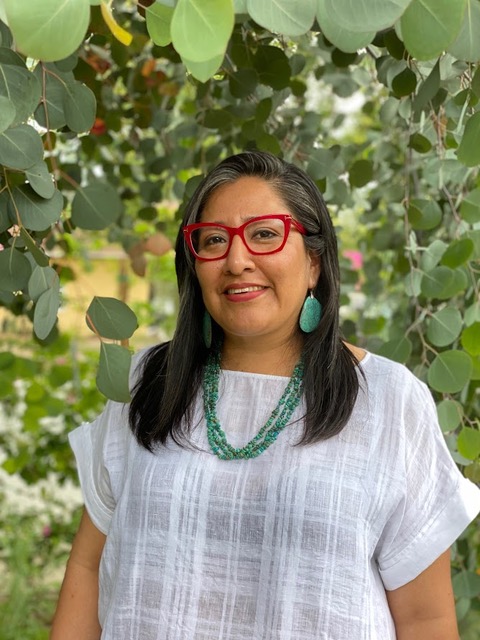
Education Leadership Program graduate Liliana Martinez-Kaufman dissertation brief uses life histories to explore and document the educational journey of adult high school diploma students and the lessons for California Community Colleges Vision 2030.
When Liliana Martinez-Kaufman was a teenage high school student in Los Angeles her father was also taking adult high school classes, working to complete his own education. They would sit at their dining room table and do their homework together.
“My dad would be doing his homework after a full day of work, and he was so dedicated and so meticulous about his studying. It was a source of inspiration for me,” Martinez-Kaufman says.
It would also prove transformative. When Martinez-Kaufman was about to graduate from college, she was unsure what she wanted to do. Her father ran into one of his former teachers who suggested she consider teaching at adult school until she figured things out. A few months later she got a job teaching English as a second language to adults. Twenty-five years later she’s still working with adult education students.
“I just fell in love with the population of students I was serving. Teaching in the community where I grew up, I had the opportunity to teach folks like my neighbors, like my parents, like my extended family,” Martinez-Kauffman says. “I still work with that population of people. They are very dedicated and motivated to learn, and they take it very seriously. They taught me how to be a teacher and how to be a better human being. So, I never stopped.”
These days Martinez-Kaufman is an associate professor at Pasadena City College, where she has taught for the past 10 years. She teaches students in the adult secondary programs who are working towards their adult high school diplomas and learning basic skills in English.
She is also a graduate of the UCLA Educational Leadership Program (ELP) earning her doctorate in education in 2025. Her research dissertation was honored by the UCLA Department of Education as the outstanding dissertation of the year.
As part of her scholarship Martinez-Kaufman recently published an ELP dissertation brief, “Using Qualitative Inquiry to Meet Vision 2030 Community College Goals: Lessons from Adult High School Diploma Students’ Life Histories.”
Vision 2030 reaffirms the responsibility of California’s community colleges to expand access to educational opportunity for working students, first-generation students, and underserved populations. And it uses student demographics and other metrics to inform interventions and decision making to meet those goals. A related goal is to meet learners where they are and ensure that “no student—or group of students—feels disaffected or alienated.”
Martinez-Kaufman’s dissertation study used life histories to document adult high school students’ educational trajectories. Her findings reveal how institutional measures often overlook the complex and non-linear ways learners persist. She contends that a deeper level of understanding is needed to understand and meet the needs of students. Narrow, quantitative measures focused on course completion, retention, and continuous enrollment do not always capture the diverse goals of learners, their resilience, and their self-defined measures of achievement. Qualitative measures such as interviews can complement and inform quantitative research.
“I really want people to understand that we have to listen to students voices, to what they have to say about their own learning, about their own experience, not just the parts that coincide with what we already think or with things that we wish would work in a community college setting,” Martinez-Kaufman says.
For the study Martinez-Kaufman conducted life history interviews and other research exercises with eleven adult high school students in a program at a community college in Southern California, enabling them to share their stories in their own words and through symbols and images.
Her findings provide understanding of each participant’s educational journey and illuminate themes that are broadly applicable to the work of community colleges. The themes that emerged include:
Students have nonlinear and extended educational trajectories. Their pathways spanned years or even decades, and were marked by interruptions, re-entry, and persistence, contrasting with common perceptions that there is a “massive dropout pattern” among noncredit students.
Students’ aspirations are fluid, shifting and expanding over time, often progressing from job related goals to ambitions for higher education.
The life experiences of students are an asset. Students bring valuable cultural and professional knowledge to their educational experiences.
Support networks are essential in navigating college. Establishing “confianza” – trusting and caring relationships with teachers and counselors—encourages students to access college resources.
Students have multiple notions of success. Community colleges often measure student success in terms of credits, enrollment, certificates or degrees, and transfer to 4-year institutions. These adult learners described success differently—as fulfillment, healing, empowerment, and personal growth.
“Sometimes I think in community colleges, we can develop tunnel vision where we’re so focused on making sure that students have the easiest pathway towards success,” says Martinez-Kaufman. “But who defined that success? Was it students? Students are telling us that their trajectories, their thinking, is not linear. Yet a lot of our pathways are very linear. Our students are telling us that their career, academic and personal exploration is evolving through the time that they are with us. Yet I wonder, do we always offer opportunities for students to pause and reflect and change their pathway once they’re on it? We need to listen to what students are telling us and perhaps question our own long-standing beliefs of the purpose of college education.”
For example, Martinez-Kaufman says that in California’s community college system, there is a lot of focus on quantitative measurements of student completion or persistence rates. Yet in the interviews she did students had a different vision of what persistence means. And it’s a lot bigger than what the community college definition is. For whatever reason, students drop out and enroll again and again, but they have an aspiration to continue their education, and they don’t let that go.
“The interviews were illuminating,” Martinez-Kaufman says. “Maybe the question should be, what is it that keeps them coming back? And when they come back, what are we as a community college, as an educational system, doing to make it a welcoming space for them to come back to and meet whatever their goals are?”
Martinez- Kaufman hopes that her research will help those who lead and work in community colleges to more effectively serve community college students and to support work towards the states Vision 2030 goals – in particular, to understand that qualitative research can help colleges to better understand and support all learners.
“I think in a different way, the life histories that I present are also a source of inspiration for practitioners, for teachers, for counselors, for people that work with students daily. I think it’s important to pause and to listen to students, to what they’re sharing with us, and to have the humility to learn what they’re sharing about,” she concludes.
“I feel like these stories are a source of strength, a source of celebration of the diversity, the resilience, and the power of the students that we work with.”
The ELP dissertation brief by Liliana Martinez-Kaufman, “Using Qualitative Inquiry to Meet Vision 2030 Community College: Lessons from Adult High School Diploma Students’ Life Histories,” including findings and recommendations is available on the UCLA ELP website.