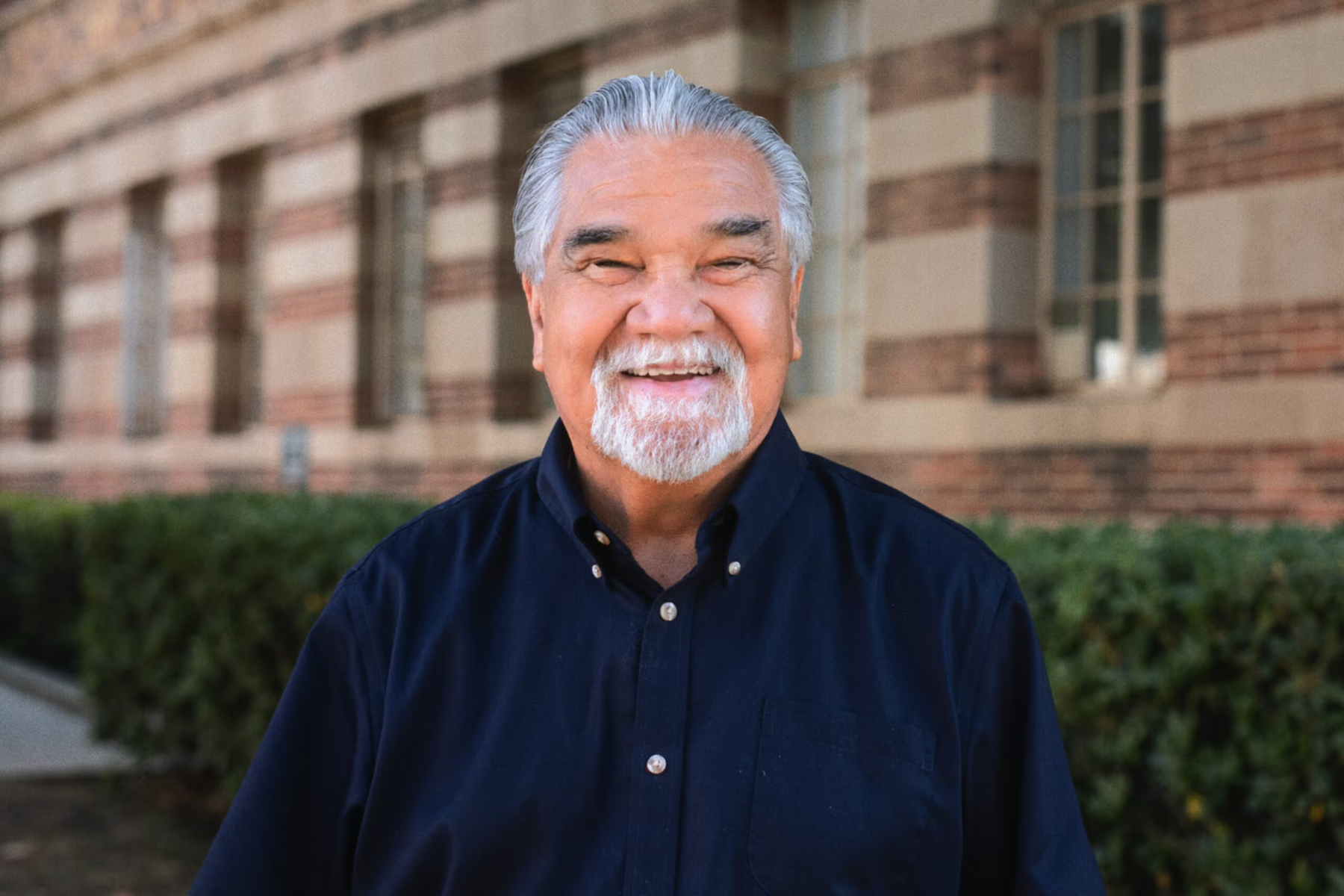
Founder of UCLA’s Center for Critical Race Studies in Education will take part in a plenary session at AERA on “Holding Fast to Histories, Holding Fast to Dreams,” Apr. 8.
At AERA this year, the opening plenary session on Wednesday evening is aptly named, considering the fact that UCLA Professor of Education Danny Solórzano is a member of a panel of scholars who will discuss, “Holding Fast to Histories, Holding Fast to Dreams.” The hallmark of his 36-year career at the University, not only as a professor and an advisor, is his mentorship of students, which lasts beyond graduation day. Over the years, hundreds of these students, now in key positions across the nation as educators, leaders, and researchers, have become colleagues, co-authors, and friends.
“Mentoring is a really important part of my teaching,” says Professor Solórzano. “I mentor from a place of respect … respect who they are, their family and community origins, wherever they come from. I try to treat everyone individually but more importantly, each of them comes to this process of working with me from a position of strength. They come with strengths, and I try to identify those strengths and build on those strengths.”
“But it doesn’t end there,” he says. “It extends to their roles—whether they go into academia, community work, activism, or policy—helping them achieve their dreams and contribute to a better, more just world.”
Solórzano established the UCLA Center for Critical Race Studies in Education in 2015 to engage students, scholars, and community members in interdisciplinary research on educational, Ethnic Studies, and social inequality—with a focus on historical and contemporary issues affecting Communities of Color.
At the heart of the center is Professor Solórzano’s Research Apprenticeship Course (RAC), which has sparked and supported the growth of Critical Race Theory among his students and beyond, as they went out into the fields of education, Ethnic Studies, activism, and policy.
“In 1993, I was introduced to critical race theory,” says Solórzano. “It was serendipitous. I came across an article in the the Chronicle of Higher Education that exposed me to something called Critical Race Theory and the Law.”
“I realized that I had to go deeper into this,” he says. “It had to expand and complement my field, which is Education and Ethnic Studies. I basically immersed myself in that legal literature and worked for years trying to understand what they were doing. Early on, I realized I needed students to help me move these fields forward—a space where we could talk about Critical Race Studies and Critical Race Methodologies. We have amazing students here at UCLA. And that’s when the RAC started.”
Professor Solórzano encourages UCLA students to attend AERA’s Annual Meeting, Apr. 8-12, which is in Los Angeles for the first time in over 30 years.
“You’re going to find all kinds of panels and sessions—start searching out the topical areas that interest you,” Solórzano says. “And seek out people you’ve read or know about in the field. Go see them, and more importantly, introduce yourself. Let them get to know you. It can spark an intellectual relationship that expands well beyond AERA in Los Angeles.”
“There may be an opportunity to search for colleagues that you’ve lost touch with … go and reconnect,” he says. “In the years past, at the UCLA reception, we have an amazing turnout of our graduates. I look forward to seeing our students who are now all over the country. I just love to be around them and to hear what they’re doing, hear about their families.”
A native Angeleno from Lincoln Heights, Professor Solórzano says that AERA attendees will find an “amazing city with amazing communities.”
“I just love this city, my hometown, and the different communities that make it up,” he says. “What’s so powerful and beautiful about LA is the richness that exists beyond Hollywood and the beach communities. There are beautiful communities all over Southern California. I hope our colleagues are able to visit, engage with them—and if nothing else, break bread. The food here is a really important way to connect with community.”
“LA doesn’t have the verticality of New York—it’s a very horizontal city, and the beauty is in all those communities spread across that space,” says Professor Solórzano. Within them, there are community organizations, parents, teachers, students, and activists doing some really important work.”
Visit the AERA website for a list of presentations by Professor Solórzano at the Annual Meeting, Apr. 8-12 in Los Angeles.
To learn more about Professor Solórzano’s RAC and the work of the UCLA Center for Critical Race Studies in Education, visit the center’s website.