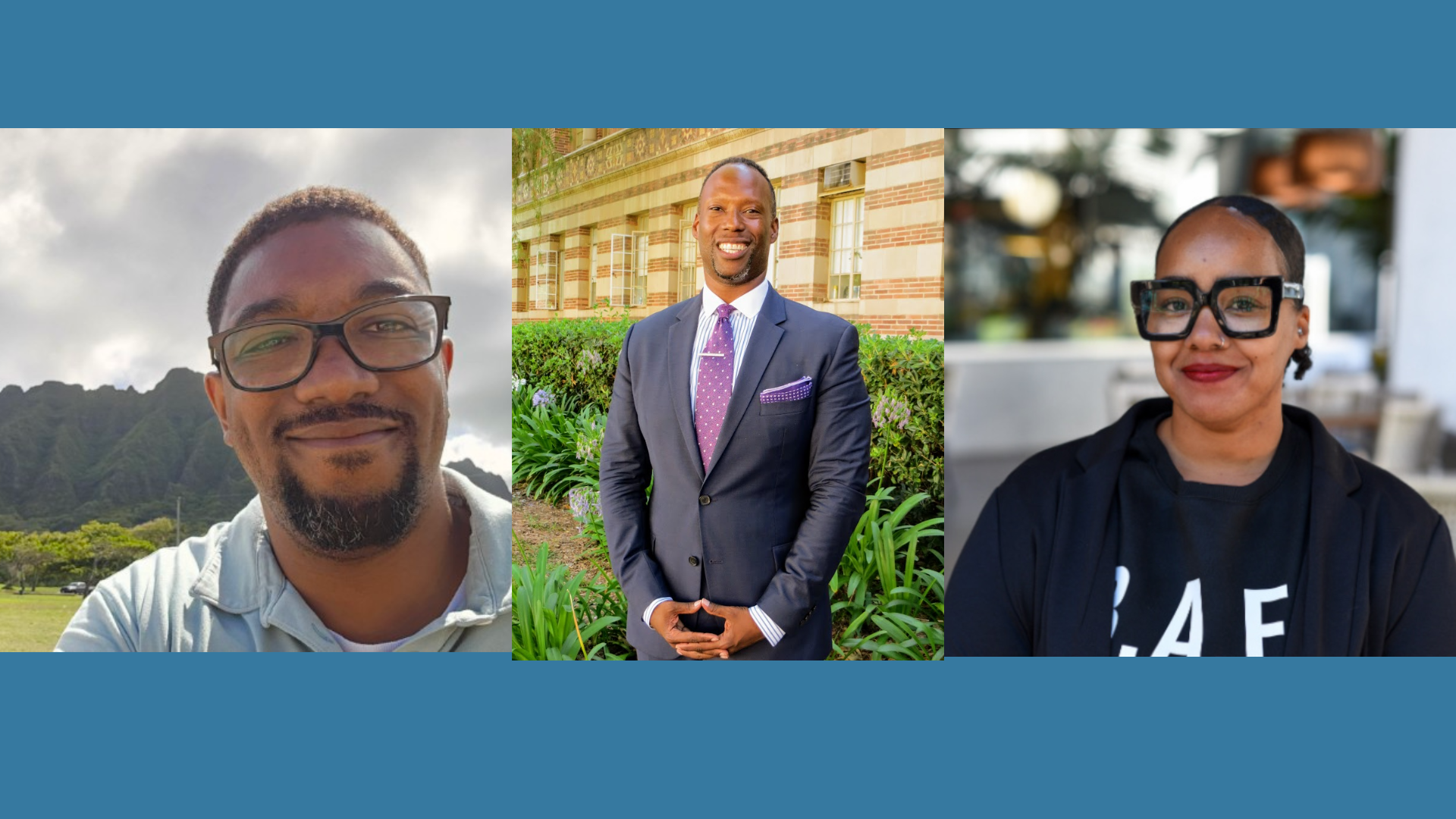
Graduates of UCLA’s Teacher Education Program and Principal Leadership Institute are making an impact on schools and communities across California.
Over the past 30 years, UCLA Center X has grown into a community of more than 100 educators working across multiple programs, led by Lynn Kim-John, executive director, Center X. These include the Teacher Education Program (TEP) and the Principal Leadership Institute (PLI), both of which aim to transform public schooling to create a more just, equitable, and humane society.
TEP, the University’s signature credential program, prepares aspiring teachers to become social justice educators, with a focus on education in underserved communities and schools in California, and Los Angeles in particular. PLI trains and supports a diverse group of working professionals committed to the principles of academic excellence, equity, and integrity as a way to maximize achievement and opportunity for students.
Alumni of TEP and PLI are making an impact on the most underserved schools in Los Angeles and across the state.
Zachary Cue, director, UCLA Science Project
A high school science teacher for 13 years, Zachary Cue became the director of the UCLA Science Project at Center X last year after serving as a science coach in the program. In addition to managing the Science Project team, he brokers partnerships with the community and looks for funding opportunities to support teachers and science educators throughout California.
“With all the changes and attacks on public education and funding for public education, there are still a lot of advocates out there and groups looking for support around science education, and in particular, our focus [and] commitment to social justice science education,” says Cue. “There is a misconception within the science community that it’s sterile from injustice and racism and sexism … a myth of neutrality and the misconception that teaching social justice doesn’t align with curriculum or align with standards when it absolutely does
“A lot of the work that we do is helping educators to see that taking a social justice stance actually benefits your students and benefits everyone because it’s not just about one group,” he says. “It’s about everyone having opportunities and speaking to their lived experiences through their learning. It makes it more relevant and meaningful for students and, it is exactly what the standards are looking for.”
A triple Bruin, Cue earned his BS in science in 2007, his teaching credential and MEd in TEP in 2009, and his EdD through the Educational Leadership Program (ELP) in 2020. He says that going through a graduate program while a classroom teacher “really made me reconsider what was important for students in my classroom [and] what skills do I really need them to be able to walk away with, and what really matters for them [and] what I need to offer.

“They need options for inquiry,” says Cue. “They need opportunities to ask a lot of questions, to kind of grapple with not knowing a lot, and figuring that out, and being able to come to their own terms, as opposed to an answer. Kids are afraid [to speak] because there’s a right or wrong answer. But if I’m offering them opportunities for synthesizing: there isn’t a right answer. It’s more like, what is the answer for you? That positioning made me restructure my course and my approaches to teaching.”
While an undergrad, Cue served as a resident assistant for the UCLA Office of Resident Life, and was encouraged by his resident director Maria Blandizzi, to apply for grad school at UCLA. He was also encouraged by Fred Freking, a UCLA staff member, to enter the STEP program, which allowed undergraduates to simultaneously earn their teaching credential while completing a bachelor’s degree.
Cue says that his experiences with Center X as a student influenced his decision to return to UCLA after years in the classroom.
“They really have a heart for the work that we do and really care about students and educators, wanting to support them,” Cue says. “That’s our goal because of the social justice commitment, not just for students, but also for educators and all people. It’s tough out there in the world, and we need allies, we need advocates, we need support systems, and that’s what Center X is about.”
Cue acknowledges his ELP Cohort 25 – known as “Terrific 25,” and Imelda Nava, TEP faculty advisor, who mentored him through the program.
“She was incredible, helping me get through the program and figure out how to be a teacher,” says Cue.
Cue says that ELP “really transformed my view on what education could look like. My approaches to how I was working with my own students really shifted because of my experiences in ELP.”
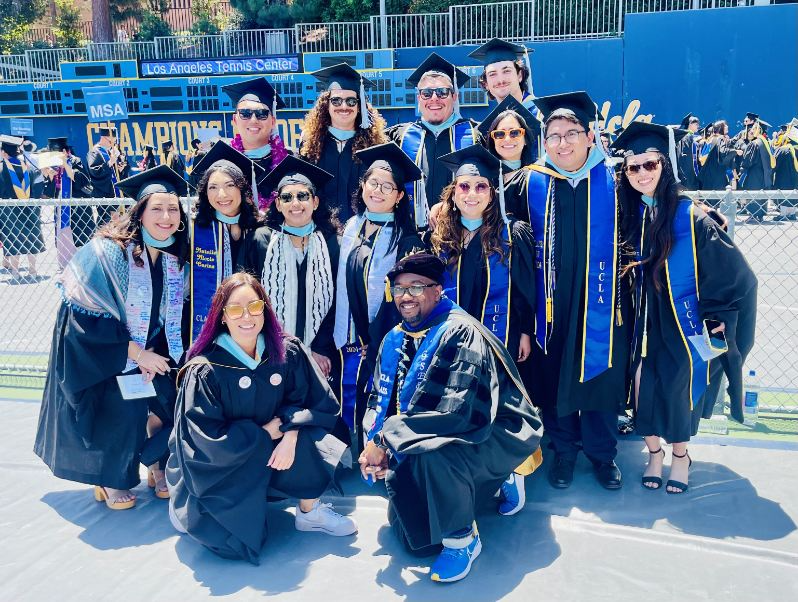
Back row, L-R: Casey Kang, Charlie Styrbicki, Miguel Villa, and Cameron Barrett.
Middle row, L-R: Ana Paula Tirado Lomas, Natalie Carias, Sana Ahmed, Victoria Garay Rosales, Madeline Nguyen, Anna De Los Santos, Norman Alvarez, and Angela Yang. Front row, L-R: Jane Kim, novice advisor, and Cue.
Courtesy of Zachary Cue
The responsibilities of teaching full-time and working while in the ELP’s graduate degree program provided a teachable moment for Cue, who shared his experience with his students in order to build understanding and trust.
“I was a social justice educator in the classroom, so to be authentic and transparent as much as possible with kids allowed for us to commiserate with each other,” he says. “Students felt more open sharing some of the things that they were having to work with outside of school, and us figuring out how to work through that together.”
Currently, Cue is working on creating summer science camps for students with the UCLA Science Project.
“We offer learning for teachers, however, students are waiting to get to experience that as their teachers learn and grow, so we should offer what that can look like for students themselves,” he says.
Cue is also creating science teacher intensives, modeled on his cohort experience with ELP.
“We can take deep dives in learning together and move towards practice,” he says. “If a teacher wants to know how to enact social justice principles in [their] classroom, then we take a deep dive together and come up with some approaches for actually implementing that in the classroom. That’s my hope for more student-facing and direct-to-teacher services.”
Krystle Goff, dean of students, Thomas A. Edison Middle School, Los Angeles
When Krystle Goff was hired two years ago as dean of students at Thomas A. Edison Middle School in Los Angeles, she was told that there were about four to five fights among the students per week. A year ago, she created a “Radiance Restored” framework, using restorative practices to enact her discipline policy and says there is “a huge difference” in the number of fights on campus now.
“There really wasn’t a strong discipline policy,” says Goff, who graduated with PLI’s Cohort 23 in 2023. “As a new dean, I knew it was my responsibility to uphold and strengthen discipline on campus. At the same time, I was sitting at the intersection of my role and identity — carrying the authority of discipline while holding everything I know about equity, disproportionality, and the lived realities of the students I serve. That tension shaped how I approached the work.”
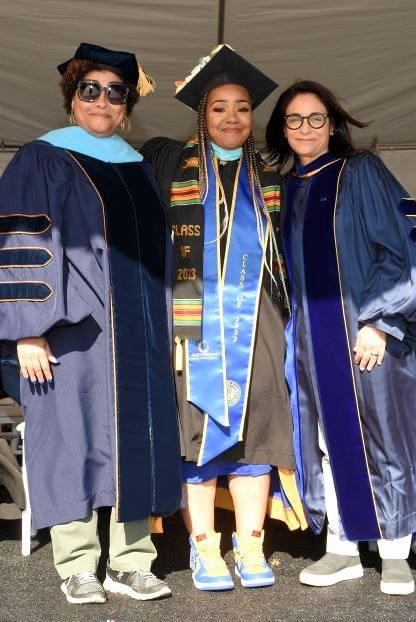
Goff found that the state policies on restorative practices included having one restorative practice occur in the classroom before a student is suspended, which wasn’t happening at Edison.
“I started to build relationship with students,” Goff says. “We know that students are carrying heavy, heavy stories. They come to school and they’re met with, ‘Take out your book,’ not, ‘Good morning, how are you today? How was your night before?’ And so, my office didn’t really feel like the dean’s office. Kids would come and unburden themselves of what they were going through and then go to class after that.”
Goff saw that rumors or students creating negative posts on social media about their peers were often the cause of the fights.
“After I de-escalated the students, I wanted to understand the basis of the fight,” she says. “I noticed that unheard stories were waiting to be told. They weren’t able to have those conversations, so I started guidance assemblies because now [they] need conflict resolution. I came up with a multi-tiered system of support that I called Radiance Restored, and I chose ‘radiance’ because after I got them through the conflict, there was just this light within them. I would have kids dabbing it up after a fight, girls were hugging, [saying]… ‘I’m sorry I pulled your hair. I’m sorry if your eyelash came off.’
“My detentions are no longer called detentions – I call them restorative periods, where we come and we reflect about our behavior,” Goff says. “And so, here we are, restoring radiance.”
Goff works in tandem with her teachers to try and resolve the conflicts within the classroom first before sending students to her office as a last resort.
“I have really wonderful teachers at Edison,” she says. “I want their eyes on it. I don’t want it to feel like it’s another check-off [item], but something that’s lived out, almost like a guide or compass of how we elevate discipline practices at the school site.
“You can create a culture in your classroom where students feel deeply connected to each other, because once they’re connected to each other, because once students are connected to each other, that connection carries beyond the classroom,” says Goff. “It always comes back to the building of community.”
Goff is a 2024-2025 Teach Plus California Senior Policy Fellow, an inaugural education leader on the California Educator Diversity Action Network and an active member of the Black Educator Advocacy Network. She achieved her BA in liberal studies from California State University, Northridge and an education specialist credential in early childhood special education and a MEd in special education from CSU Dominguez Hills. Goff is an active member of the Black Educator Advocacy Network.
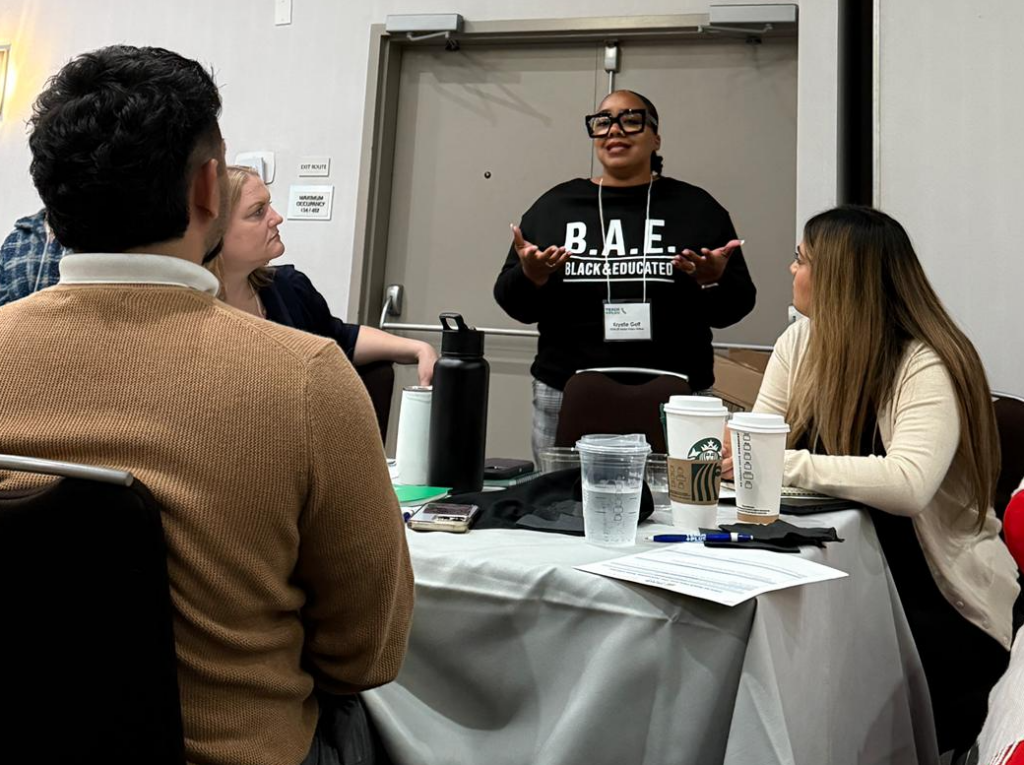
Building community is a theme that runs through Goff’s experience. She says that staying in touch with her fellow cohort members as they navigate their careers is an example of “communities of practice. That cohort was the model of how it should be done at the school level, with all the stakeholders there.
“We’re still sort of anchored to each other because of the process,” Goff says. “It wasn’t a matter of do we all agree with educational policy or do we all agree on how students learn. It was a shared space, where equity is at the center and that was the agreement of us all.
“Coming out of the program, it was almost like I was in ‘The Matrix’ – that I would see systems in a different way that I didn’t see before,” says Goff. “My work is more intentional because of Center X. My moral compass is sharper because of Center X. My confidence has grown because of Center X. Dr. [Tonikiaa] Orange (director of ELP and the Culture and Equity Project at Center X) has a way of fine-tuning your voice so you can can speak … with a spine and with confidence. We learned about power and how that shows up in the school community. And so, it is transformative.”
Torray Johnson, principal, New Vista Middle School, Lancaster
Torray Johnson is the principal of New Vista Middle School in Lancaster, a PLI graduate of Cohort 7A and an alum of TEP (’07). He says that his career has been greatly influenced by his choice of UCLA for an advanced degree.
“I could have gone to prepare for an admin credential [at multiple] schools,” he says. “What sold me on UCLA was the idea around social justice and wanting to be in schools and around people during conversations that had to do with supporting students who looked like me.
“PLI set the stage for that,” says Johnson. “All of the professors in the program … didn’t just speak from a research standpoint. They led us to have those conversations amongst ourselves … and to build colleagues down the road. I had some idea that could be a part of a framework for me as a leader, and it has proven to be exactly that. I have a network of colleagues [to] refer to when I need help trying to tackle some of these big problems that we see in urban systems.”
A Los Angeles native, Johnson attended LAUSD schools. He graduated from Bravo Medical Magnet and went on to achieve his bachelor’s degree at Dillard University. Before arriving at New Vista three years ago, Johnson served as a vice principal of special education and in student services in the Antelope Valley Union High School District and as an assistant principal of student services at Beverly Hills High School.
Johnson entered the PLI program while a teacher and after 12 years in the classroom, decided to move into administration “to see what the system actually looked like and how could I contribute to the system.”
“PLI really taught me to think critically about how to support families, how to support school communities, because you’re using data to help drive instruction, data to drive the conversations that you have with school, the school community and with families,” says Johnson. “Principalship is hard across the board, but [when going] into a school that historically has had challenges … I just leaned on, ‘what did you learn in PLI…as a systems-level leader?’ to get [started].”
The UCLA network that is a hallmark of a Center X education has also aided with Johnson’s responsibilities around curriculum. Teachers at New Vista Middle School have benefitted from the expertise at the UCLA Science Project with professional development.
“Every time I need anything instructionally related, I’m go to Center X,” says Johnson. “What I found last year from my science and social studies teachers is they didn’t feel like they had enough professional development from our district office to create the materials that they need to be successful. So, I went to Center X [to] bring in the Science Project and the History-Geography Project to support those two content areas and it’s been a really positive relationship.
“The individuals who are leading the Projects both received their doctorates from UCLA, so it’s like we all are pouring back into the system, all gleaning [from] the instructional work that we know to be great from Center X,” he says.
Johnson acknowledges his cohort and “Nancy Parachini for being the most amazing leader of PLI, and [Professor of Education] John Rogers for the work to think about from the policy standpoint.” He also thanks Professor Robert Cooper and his use of “The Miner’s Canary” in his courses, which Johnson says is “definitely a book that helped me think through a lot of things on how to be a good systems-level leader.”
Johnson says that alongside the network that PLI alumni maintain after graduation are the on-the-job lessons that instructors like Nancy Parachini, executive director of School Leadership Initiatives & International Programs at SEIS and former PLI director, shared in the program.
“When you’re a principal, sometimes you feel like it’s a thankless job,” he says. “But then you realize, I’m in the middle of data, I’m creating a master schedule, I’m creatively spending money. And at the heart of it, I see students. I see student outcomes, and through student outcomes, I work with teachers to build their capacity.
“I’m not in the classroom every day, so that’s what you think about when you’re a systems-level leader. How am I going to be able to support kids? You do that through your school plan … through the goals that you create, through the professional development that you establish, through the budget you’re offered. Knowing how to do that and think about things through an equity lens – that’s what PLI taught me to do.”