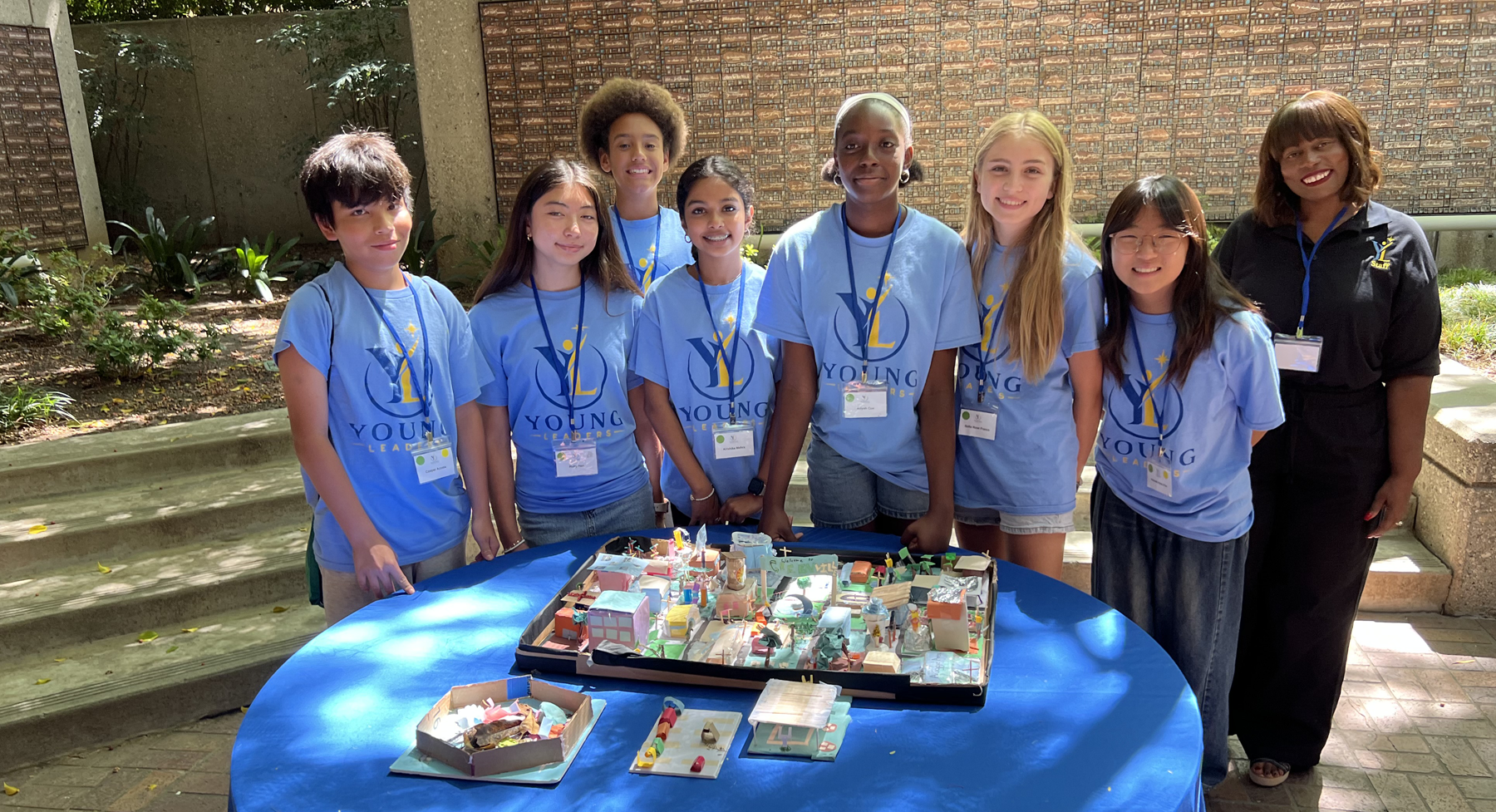
Design-Based Learning and the World Building Framework guides Pasadena middle school students in a place-based actions civics experience.
A pilot program, “UCLA Young Leaders at PCC,” imagines how urban planning would look if it included the perspectives of young people, using their voices to create communities they would be happy to grow up in and possibly, remain a part of. Held for ten days in July at Pasadena City College, the camp integrated history-social science, science, and Design-Based Learning to offer middle school students a meaningful place-based action civics experience. The collaboration was made possible with support from the Andrew Carnegie Foundation.
Using their own city as an entry point, students from across Pasadena Unified School District (PUSD) were placed in teams to answer real-world issues that cities face, including homelessness, climate change, sustainability, food scarcity, and disaster recovery.
“UCLA Young Leaders reflects UCLA Center X’s commitment to working with and learning alongside communities,” said Lynn Kim, executive director of Center X. “We want students to engage with local history and context, ask meaningful questions, and respond to real challenges. At the heart of this work is student voice and agency—helping young people see that their ideas and experiences matter, develop their identities as learners, and recognize their power to shape their communities.”
UCLA Center X researchers designed the Young Leaders program using expertise across the University. Danny Diaz, director of the History-Geography Project, Zachary Cue, director of the Science Project, and Dave Cameron, interim director of the Design-Based Learning Project, leveraged the World Building Framework created by UCLA Professor of Education Nicole Mirra, as well as the work of planning departments in Santa Monica and Pasadena, which have addressed histories of displacement via restrictive housing covenants and urban renewal programs.
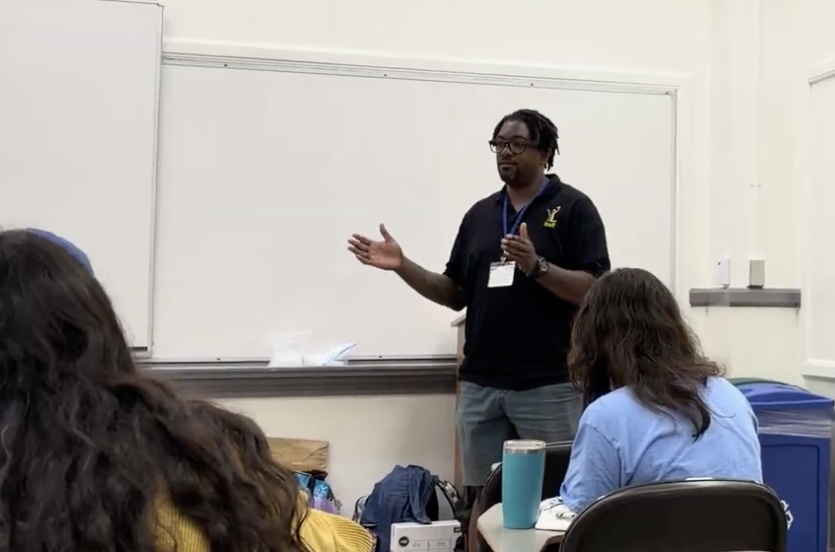
“Pasadena provided the ideal community to pilot the Young Leaders program,” said Diaz. “The city’s proximity to UCLA and its existing institutional connections facilitated deep research into the historical impact of freeway construction on the displacement of communities of color.”
To further support their inquiry, the students used research from UCLAs Institute of Transportation Studies, including a storymap titled, “Freeways, Redlining, and Racism: A History of Pasadena and its Freeways in the 20th Century,” and the report, “Exposing Freeway Inequalities in the Suburbs: The Cases of Pasadena and Pacoima.” In addition, the student teams’ knowledge was enhanced by a recent UCLA Magazine article on how UCLA scientists are helping to better understand the dangers of increasing temperatures, and why shade is a secret weapon in mitigating the dangers of increasing temperatures.
Students were given context from a “community icon” that provided a lived experience from which to build a city that welcomes all. Examining the life of legendary athlete Jackie Robinson and his family’s struggles with racism despite the end of redlining, enhanced their historical inquiry as they studied the development of the 210 Freeway in the 1960 through Northwest Pasadena, using UCLA research.
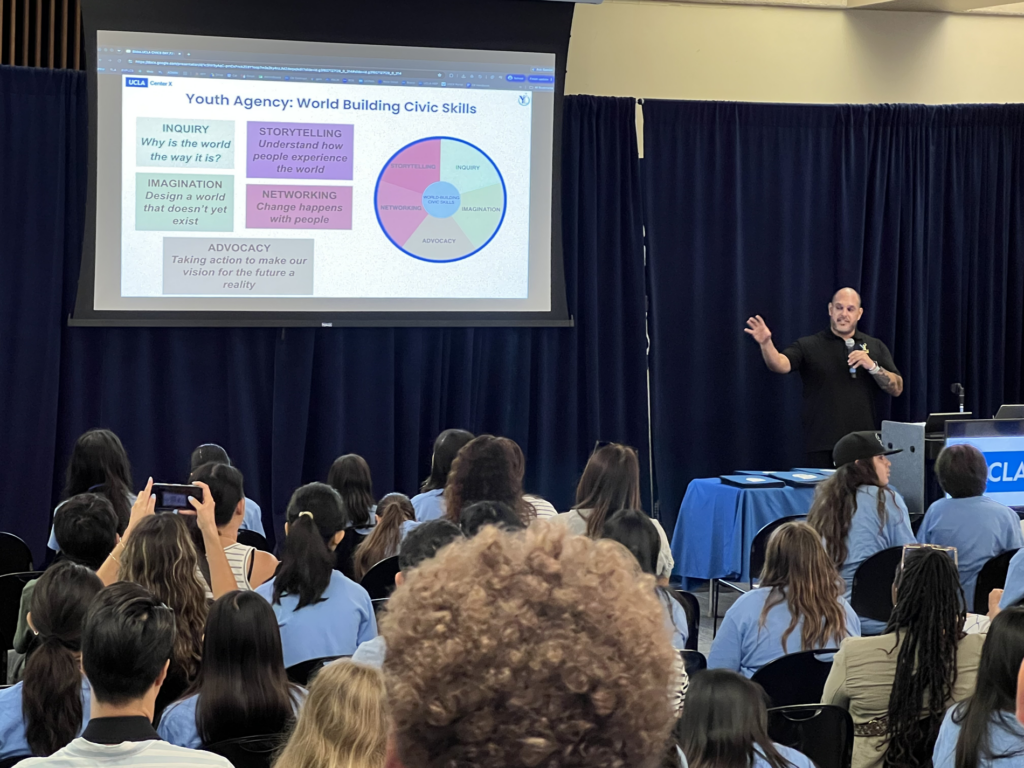
“Pasadena is one of the few cities with a planning division actively looking to address the harm caused by ‘eminent domain’ and urban renewal projects,” Diaz said. “We used Jackie Robinson’s story and his family’s experiences with racism in Pasadena as an entry point to explore housing segregation and the ways past civic leaders shaped the community, bolstered by federal policies such as redlining.”
Cue, an alumnus of the UCLA Educational Leadership Program, said that examining Robinson’s life in Pasadena provided “an opportunity for students to discuss civics in terms of how we use democratic power to address social issues.
“[Jackie Robinson] was not actually born in Pasadena but moved [there] when he was one year old,” said Cue. “The development of the 210 Freeway displaced a lot of Black and Brown communities, and [his was] one of those communities. In fact, you can’t find his house … they knocked it down. They put a plaque there, where his house would have been… between two houses.
“Exploring these very real, deep civic issues by looking at them through the lens of a real-life person, really allowed opportunities for students to engage in those conversations in beautiful ways,” he said. “Their cities are built to reflect that. What does fair housing look like? What does that mean for citizens not to be racialized or marginalized in any way, right? How do we make sure there is access and everyone’s voices are heard?”
Through scientific investigation, students explored the long-term impacts of racially exclusionary housing decisions and discovered that certain locations allocated to specific racial groups are now Urban Heat Islands, mirroring data across the nation. During the camp session, Alesia Montgomery, an assistant professor at UCLA’s Institute of the Environment and Sustainability, spoke to the students about her research on heat equity, and U.S. Representative Judy Chu, a UCLA alumna, spoke to the students about her work as an activist in Monterey Park, where she helped to organize and defeat a racist bill targeting the Chinese American community and how that experience propelled her to her current role in state and national government.
“Rep. Chu encouraged them to use the camp experience as a pathway to stay engaged in their community and to run for office one day,” said Diaz. “She shared her story and how that set the stage for where she is today.”
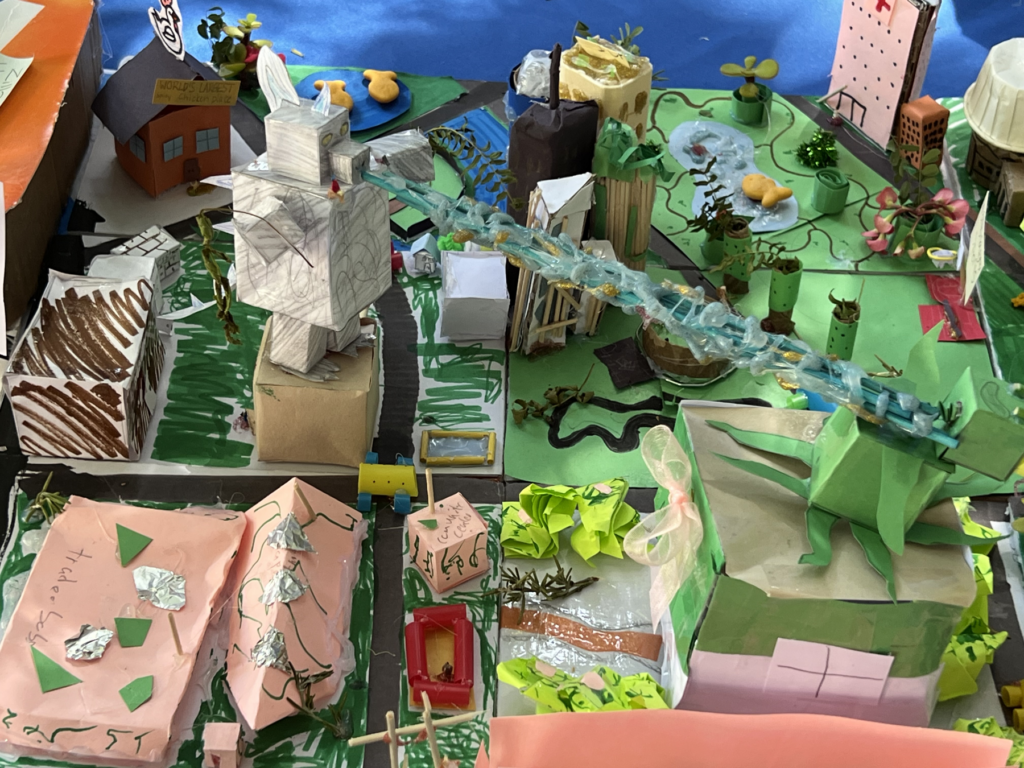
During the second week of the camp, the students began building “Never-Before-Seen” reimagined versions of Pasadena districts, using the Design-Based Learning approach to build 3D models depicting solutions to specific civic problems they identified. The models were showcased on July 31 at UCLA and families, PUSD leadership, PCC administration, officials from the City of Pasadena officials, the civics team from the Los Angeles County Office of Education (LACOE), and UCLA staff and faculty were invited to attend and view the students’ work.
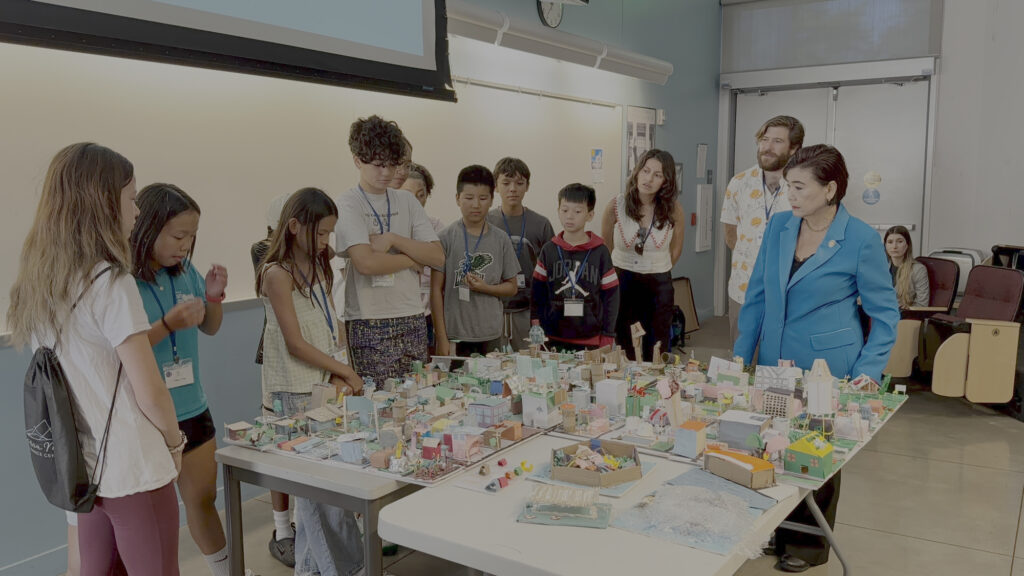
Shomara Gooden, a teacher leader with the UCLA History-Geography Project and a middle school teacher at Cesar Chavez Middle School in Lynwood, said that the Young Leaders program is “… a beautiful convergence of a lot of things that we say are important in the classroom.” She looks forward to sharing her experience with her 8th graders, “bringing this vision to life of what civics and history and science can look like, and how we can reimagine our future using input from from young people.
“They’re looking at technology and science in ways that how can we build something that suits the needs of all,” said Gooden. “We looked at ideas of power and community and how we can be democratic – power within, with student voice [and] student leadership, as opposed to power over.”
Gooden said that looking at Robinson’s story transcended how he is typically viewed as “an icon of UCLA and of sports. He had a really tough time as a youngster, growing up in the city facing racism. It was a place where he could live but it wasn’t a place where he felt like he could have an abundant and safe life.
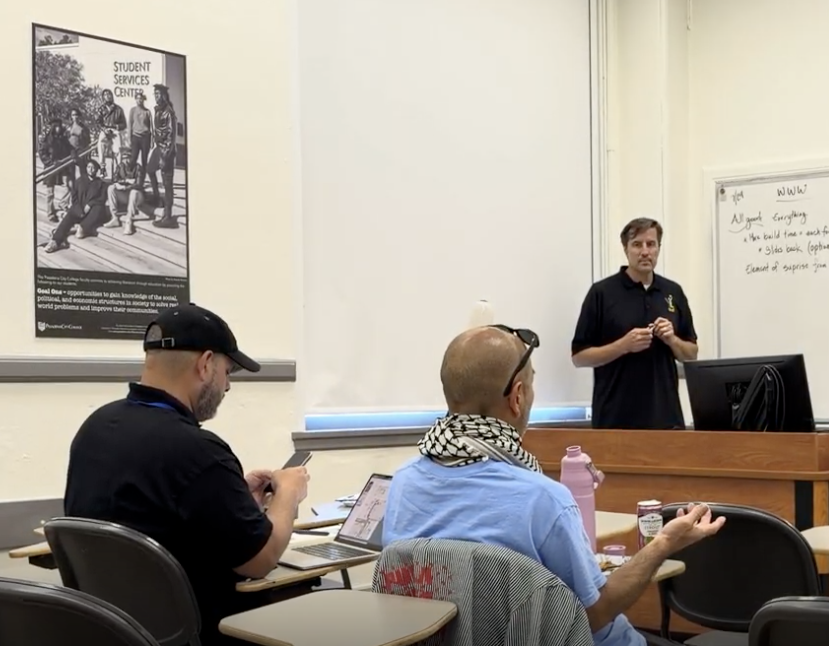
“Looking at some of those … factors to the city, it was a context for the students to think about … as we build [our dream city], we would never want someone to think, ‘I don’t want to return to the city because of racism… because my house was displaced.’”
Diaz said that while Pasadena, like all cities, faces housing and climate challenges, many of these issues can be traced back to specific civic decisions of the past.
“As the city grapples with climate change and considers various adaptive approaches, it offers a robust network of community activists and organizations that serve as prime examples of democracy in action,” he said. “Our students analyzed these data points and attempted to integrate them directly into their city redesigns.”
Created by one of the student teams, the model of “Greenville” featured a homeless shelter, awnings to provide relief from the heat in outdoor spaces, a small farm to sustain food production, and a landfill carefully placed on the outskirts of the city.
Ariyah Cue said that when her team started building Greenville, “Everyone had their own tiles, and they were just working on their own. But when we went more into the week, people put their tiles together so we could make bigger buildings and work together on real problems.”
“A lot of our buildings changed because at first, we all made one thing [on our own],” said Sofia Rose Franco. “But as we put it together, we realized a lot of the stuff might not be needed or that some of the stuff doesn’t fit, so we had to take stuff off, move it places and also remake things.”
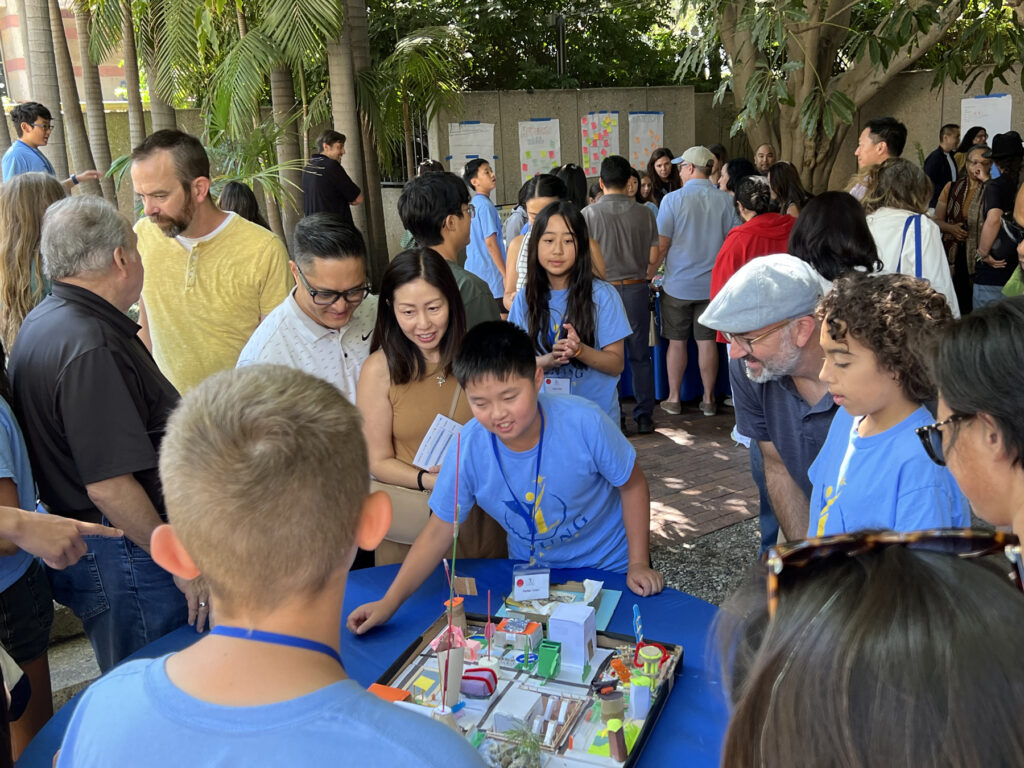
The team has taken lasting lessons from building “Greenville” that they will take into their upcoming school year. Franco said that that the team’s city design is “pretty realistic. I think that a lot of the stuff can be done.” Cue noted that she will “start sharing more ideas. If there’s an opportunity, I will speak up.” Krishika Mehra said, “We learned leadership… and now we can implement that in our daily lives.”
Doreen Gehry Nelson, sister of the late renowned architect Frank Gehry, earned her bachelor of arts degree and elementary teaching credential in 1959 at UCLA. Currently the founding director of Design-Based Learning and professor emerita at Cal Poly Pomona’s School of Education & Integrative Studies, Gehry Nelson created Design-Based Learning methodology while teaching in Los Angeles public schools during the late 1960s. Her innovative curriculum, no used by K-12 teacher around the world, aims to ignite creativity, promote a high-level transfer of learning, and foster cross-curricular critical thinking skills.
Zachary Cue said that he, Diaz, and Cameron are thinking about how to take the Young Leaders project to other cities, again using a community icon to humanize history and civic decision making for students.
“For example, if we were to do this camp in Pacoima, we would look at Ritchie Valens and his experiences,” said Cue. “It really makes it more tangible for students when there’s a Jackie Robinson… this person they can see. You never hear about [Robinson’s] experiences growing up. You just hear about him being this baseball player and everything’s great.
“There was this one quote that we found [from] the 1970s or 80s,” said Cue. “They asked him about his experience in Pasadena and he said, ‘If my family didn’t live there, I would never go back,’ because of his experiences with racism. I think that’s important for students to consider. Things aren’t always happy. However, we need to dream about… how do we build opportunities where everyone actually wants to go back to their communities.”