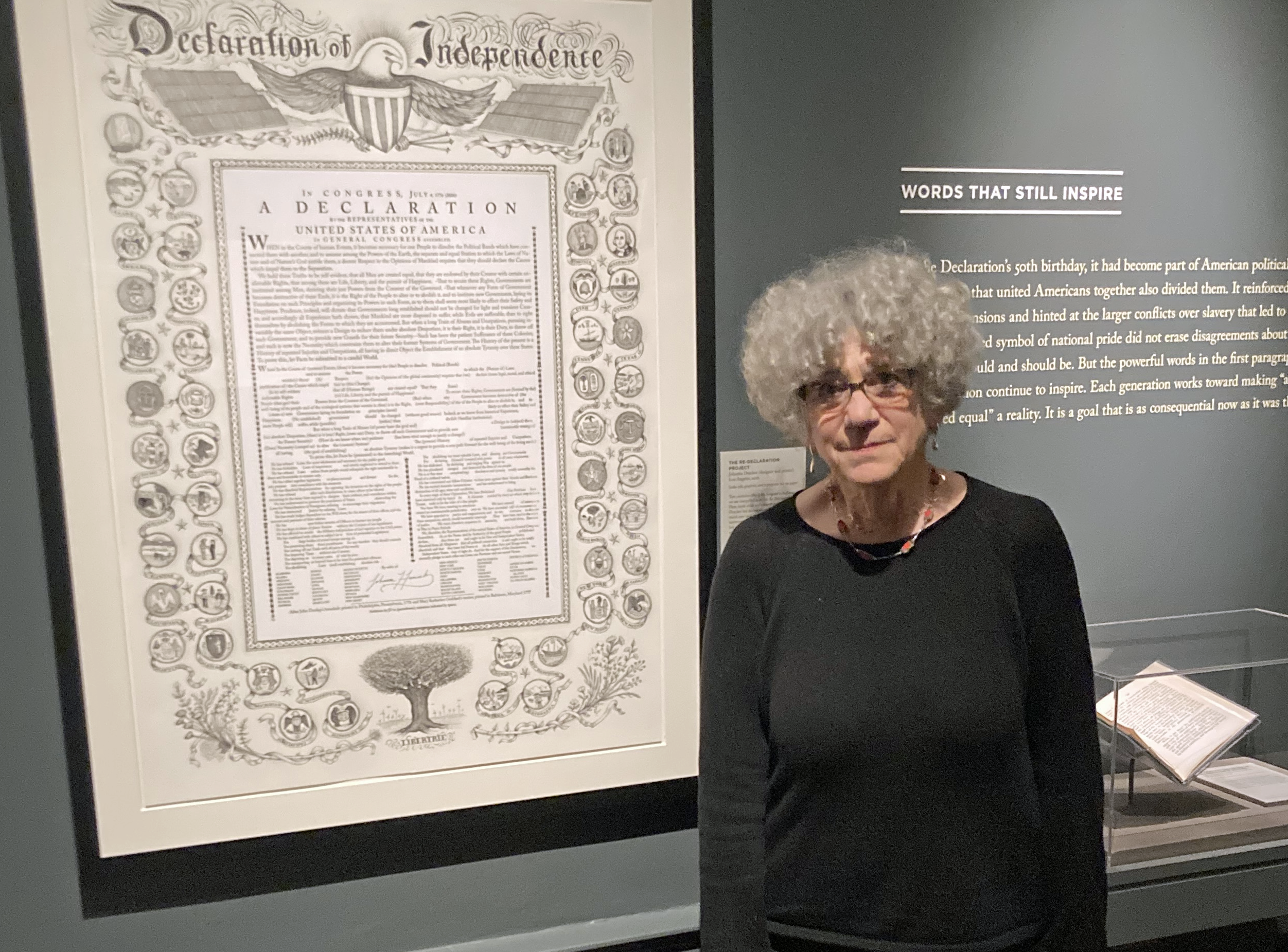
Scholar of the history of the book commissioned by the American Philosophical Society to reimagine the Declaration of Independence.
Johanna Drucker’s ties to Philadelphia go even further back than her own family’s history. The Distinguished Research Professor Emerita recently returned to her hometown to speak on her most recent work, “The Re-Declaration Project,” commissioned by the American Philosophical Society (APS).
In April, Drucker, the inaugural Breslauer Professor Emerita in the UCLA Department of Information Studies and a member of the APS since 2023, helped kick off the exhibit, “These Truths: Declarations of Independence” and spoke about her creation of “The Re-Declaration Project” at the organization’s April meeting at Philosophical Hall. The master printer discussed her process of reenvisioning the Declaration of Independence, adapting it from historic printings of the document and updating it in subtle, yet profound ways, both textually and visually.
“I haven’t lived in Philadelphia for a very long time but I still feel a very strong connection, especially to that part of the city,” says Drucker. “The society’s museum and library is on the same block as Independence Hall.”
The oldest scholarly society in the United States, the APS was co-founded in 1743 by Benjamin Franklin and other scholars and thinkers of the day. Drucker says that the project has a great deal of resonance for her. While visiting the society’s library in 2025, she was treated by Dave Gary, APS librarian, to a viewing of various artifacts that were to be shown in the “These Truths” exhibit, including a 1776 printing of Thomas Paine’s “Common Sense,” the chair that Thomas Jefferson sat in while writing the Declaration of Independence, and an 1819 version of the Declaration by printer John Binns,
“I’m a printer, an artist and scholar of print and print history, so I was over the moon over every artifact … I was geeking out,” she laughs.
Professor Drucker says that a month later, Gary and Mary Grace Wahl, associate director of collections and exhibitions at the APS, asked her to create “a contemporary commentary, reinvention, [or] continuation of the Declaration.”
“Part of what they were thinking about was the role of women and women printers within the history of American culture and politics,” recalls Drucker. “A lot of people don’t know that the original declaration is the broadside [that was] printed overnight [on July 4, 1776] by John Dunlap and on July 4th a year later, a woman named Mary Katherine Goddard in Baltimore who was a printer [and] a publisher, printed a second version of that document.
“It’s word for word the same as Dunlap’s,” she says. “[There are] a couple commas that are different, but he had a one-column format, she had a two-column format, and her paper’s an inch wider. Otherwise, they’re the same. The Goddard broadside is even more rare than the Dunlap, and [the society] couldn’t get a copy.”
Professor Drucker says she was honored and felt a strong affinity with the APS’s request, as there is no record of another woman printer in the society. With “The Re-Declaration Project,” she adapted the aims of the Declaration as evergreen by removing references to the Revolutionary timeframe, using the conceptual writing approach of erasure.
“The hardest part [was] trying to think how to be respectful to this text while also doing something that would be a meaningful intervention,” she says. “What I wanted to do with my text was to erase the historical specifics of the Declaration so that [its] principles … would come forward into the present. It’s about these truths, and what we hold to be self-evident.
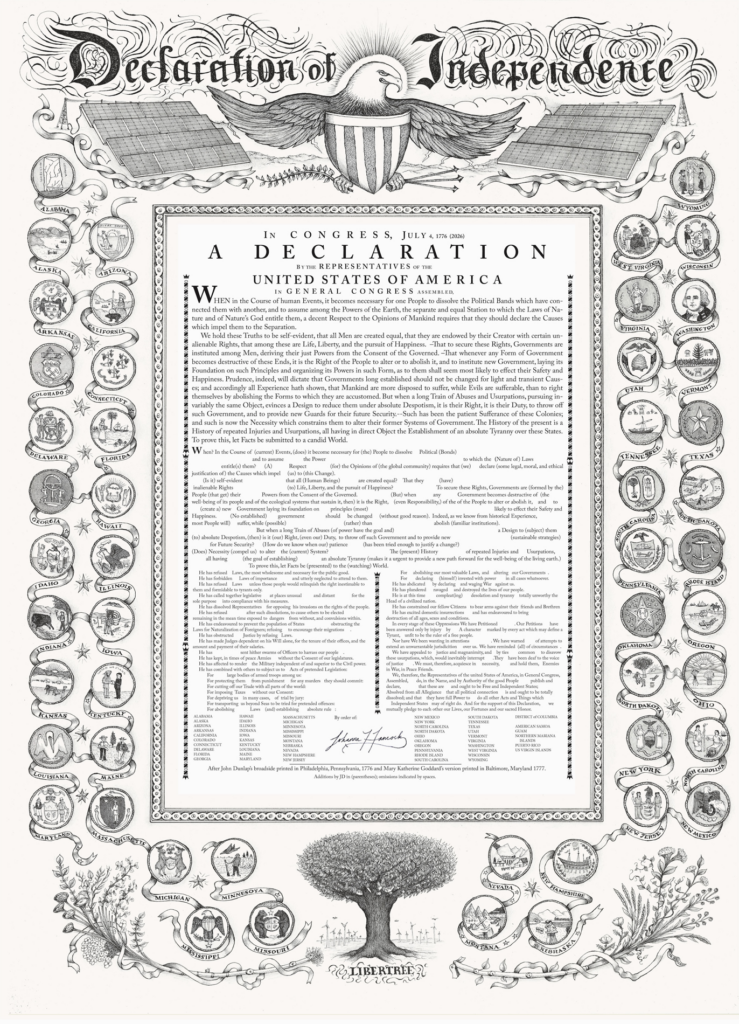
“I substituted one or two words, and those are indicated in parentheses,” says Drucker. “The rest … are the exact words of the John Dunlap broadside that the committee of Jefferson and Adams and all those writers [had] put together. Underneath that, you start to see what looks like a moth-eaten text. The moth-eaten text is the same text as the text above, but with words left out.
“And then when you get down to the accusations. There, I adopted the Mary Katherine Goddard format of two columns. It’s the same text – I just left out the specifics of who’s being talked about. Instead of ‘when King George III does this,’ there’s no ‘kings.’”
Drucker’s design development included not only drawing 50 state seals by hand with a Crow Quill pen, but having to plot their precise spacing, all of which took her a month to do.
“Those are based on the [actual] state seals and the challenge there is only one and a half inches each to fit them all in,” she says. “The frame drawing is an adaptation of an 1817 steel engraving by Binns, which is quite beautiful, but he only had 13 states to deal with. There’s an incredible amount of information in a lot of these seals – lots of eagles, plows, and classical figures. I drew more plows than I have ever done in my life.”
Professor Drucker also added the names of U.S. territories of the District of Columbia, Puerto Rico, and Guam on the printed broadside, and updated the traditional iconography on the frame.
“Where the Binns [broadside] has elaborate drapery up near the eagle, I put solar panels… and a wind farm down below,” she says. “Independence means energy independence!”
Professor Drucker signed her work, “Johanna Hancock,” a humorous homage to John Hancock, the second president of the Second Continental Congress that adopted the Declaration of Independence on July 4, 1776. She notes that during the time of the Revolution, it was also not uncommon for thought leaders such as Franklin to also be professional printers.
“As the 19th century progressed into industrial methods, a kind of hierarchy in the industry separated people who were working on the shop floor from people who were part of the executive management,” she says. “We see this in a lot of industries. So, the profile of the scholar printer, which had been in place since the Renaissance, started to kind of disappear.”
A letterpress book printer for 40 years, Drucker says she was drawn to the art of printing because of her own writing.
“I was a writer from the time I was a child,” she says. “I printed my first book in 1972. In the 1960s and 70s, there was no way to have your work look like it was print. I wanted my work to be authoritative and legitimate and the only way to do that was to print it myself, to put it into handset type … and then it was a book.
“Digital printing and computational typesetting was still ahead,” says Professor Drucker. “We were all young printers in the shop, poets and writers. As a young writer, you could not believe that your work was now in print. It was real. It wasn’t a manuscript, it wasn’t a typescript, it was print.
“My dad was a commercial artist, and he used to spec type and send out an order and get back photopaper with type set on it. I kind of knew about that process a bit as a kid, but to me, it was like, [sic] I want to be a writer. I’m dreamed of geting galleys.”
Drucker says that she hopes “The Re-Declaration Project” will provoke honest thought and discussion of what the document means and should provide for the United States today.
“The re-evaluation of the Declaration has occurred many times in its history, particularly in light of the issue of enslaved people and the question of who has rights and is ‘created equal,’” she says. “My goal was to find a way to address this by not falling into either celebration or reductive revisionist critique. These do not open a space for conversation about where we are as a nation, a people, and how we envision a future in which ‘these truths’ can be fulfilled with respect.
“Democratic principles need to be actively debated if they are to be useful,” says Professor Drucker. “We inhabit a different world from that of 1776 and we have to take responsibility for continually reflecting and acting on our values. I hope my piece will prompt viewers to the exhibit to think about what they want to preserve and what they believe should be reformed.”
To view Professor Drucker’s talk for the American Philosophical Society on “The Re-Declaration Project,” visit YouTube. (Drucker’s segment begins at 3 h:42 min.)