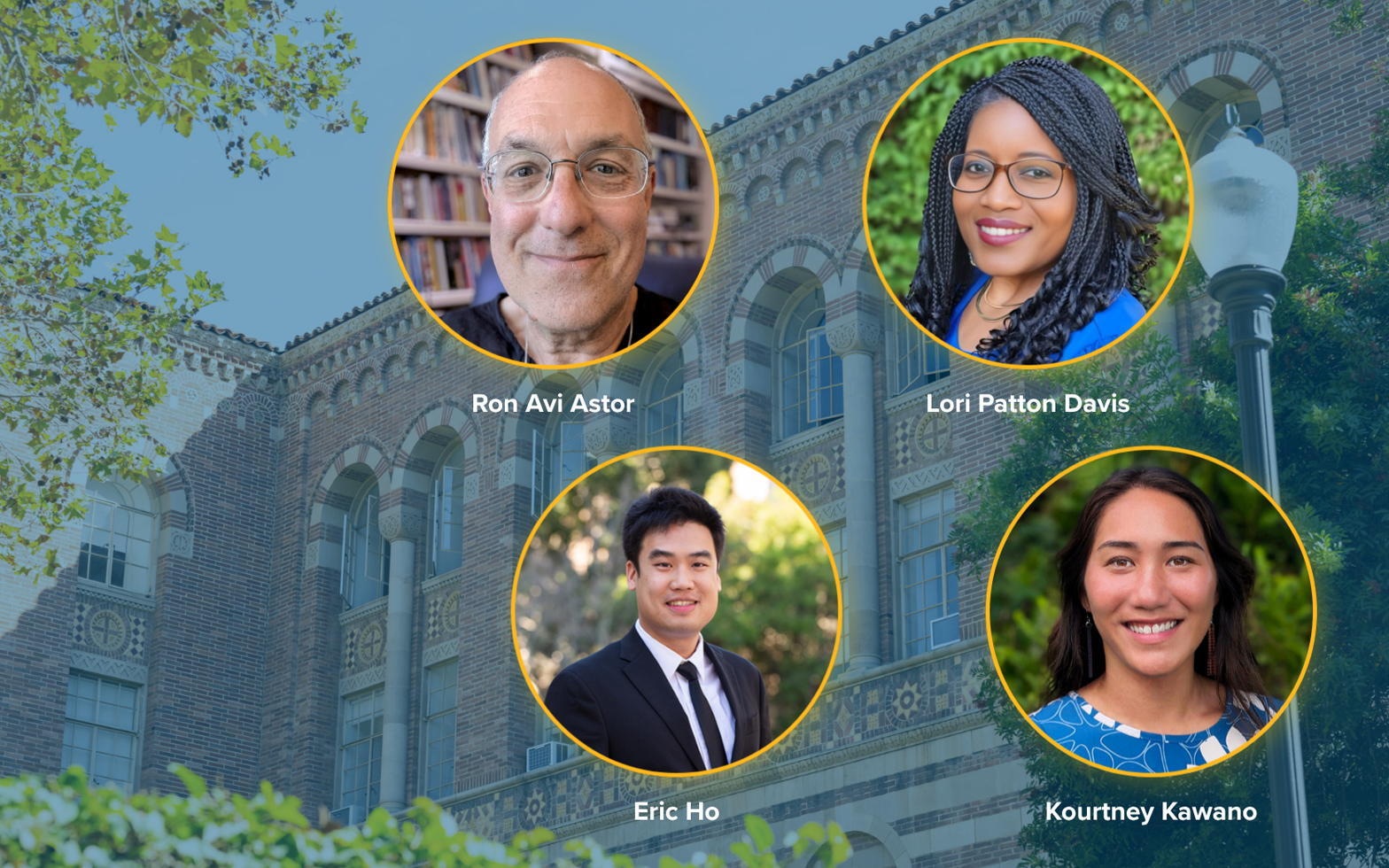
UCLA professors Lori Patton Davis and Ron Avi Astor, Ed&IS alumni Kourtney Kawano and Eric Ho recognized for groundbreaking research and publications.
Four award winners from the UCLA School of Education and Information Studies, recognized for their research and publications in some of the most critical issues in education, will be honored at the annual meeting of the American Educational Research Association (AERA), Apr. 8-12 in Los Angeles. These include Lori Patton Davis, professor of education, who has been honored with the Henry T. Trueba Award for Research Leading to the Transformation of the Social Contexts of Education; Ron Avi Astor, professor of education and social welfare, who has been recognized with the AERA Division E Distinguished Research Awardee in Human Development; Eric Ho, lecturer, who has received the 2026 Palmer O. Johnson Memorial Award; and UCLA Education alumna Kourtney Kawano, who has been honored with the Distinguished Dissertation Award from AERA’s Division G- Social Context of Education.
“Please join me in celebrating the outstanding achievements of Professor Lori Patton Davis, Professor Ron Avi Astor, alumnus and lecturer Eric Ho, and alumna Professor Kourtney Kawano, each of whom has been recognized with well-deserved AERA honors,” says Wasserman Dean Christina Christie. “Your scholarship, dedication, and passion for transforming education are an immense inspiration for our entire community. Congratulations!”
Patton Davis has been honored with the Henry T. Trueba Award for Research Leading to the Transformation of the Social Contexts of Education, which recognizes a scholar or group that has made distinguished contributions leading to the transformation of the social contexts of education.
Patton Davis, who is the faculty director of the UCLA Educational Leadership Program and the Heyman Endowed Chair in the UCLA Department of Education, is best known for her research on the effects of race and racism in higher education, the experiences of Black girls and women in educational and social contexts, college student development, and the impact of campus diversity initiatives on student success.
Professor Patton Davis expresses her gratitude for the nomination by Shaun Harper, provost professor at the USC Rossier School of Education, with support from Eboni Zamani-Gallaher, the Renée and Richard Goldman Dean at the University of Pittsburgh School of Education; and Tyrone Howard, UCLA professor of education and former AERA president.
“What I appreciate about this award is the fact that it’s not attached to any particular rank, but is more about the work you’re doing, and the change that is coming about as a result of the impact of that work,” says Professor Patton Davis.
“When I think about transformational things, I am thinking about ways that bring greater understanding to the things we see every day,” she says. “I want people to understand that there are consequences for the most marginalized young people, if we don’t humanize them and help others to see their humanity. That is the driving piece around my work, especially as it relates to Black women, identifying ways to … make them seen as full, whole humans who deserve to have full lives.”

Professor Patton Davis recently led the Mary Jane Legacy Project, the first-ever nationwide examination of Black women’s post-secondary trajectories across various institutional contexts, funded by the Spencer Foundation. Created in honor of Mary Jane Patterson, the first Black woman to earn a college degree in 1862, the project is comprised of a digital archive containing more than 100 interviews with Black women college graduates.
While Black women are considered the most educated group in the U.S., they still experience poverty, the highest student loan debt, and significant pay inequity. Patton Davis and her research team partnered with The Century Foundation to release three policy reports based on data from the Mary Jane Legacy Project, including “Persistence and Resistance: Black Women Navigating Barriers in Higher Education,” “Centering Black Women’s Experiences Regarding College Choice,” and “Black Women’s Experiences Financing Their College Education.”
In 2021, Professor Patton Davis delivered the AERA Brown Lecture at the association’s virtual annual meeting, reframing the legacy of Brown v. Board of Education and its implications for recognizing the contributions of Black women and girls, the role of higher education institutions in the desegregation fight, and understanding the unrelenting nature of white supremacy in education and society. Patton Davis was named an AERA Fellow in 2022 and has been honored with the Foundation Pillar of the Profession Award from NASPA-Student Affairs Administrators in Higher Education.
Patton Davis’ publications have indelibly transformed scholarship around preparing higher education leadership to address the needs of diverse student populations while propelling them to academic and personal success. These include, “Embracing Queer Students’ Diverse Identities at Historically Black Colleges and Universities: A Primer for Presidents, Administrators, and Faculty,” “Culture Centers in Higher Education: Perspectives on Identity, Theory, and Practice,” “Student Development in College: Theory, Research, and Practice,” and “Critical Perspectives on Black Women and College Success[LPD1] .”
Prior to joining UCLA, Professor Patton Davis was a professor and department chair at The Ohio State University. She is a former president of the Association for the Study of Higher Education (ASHE), the first Black woman to serve in the role, and a member of the National Academy of Education. Often listed in Education Week’s RHSU Edu-Scholar Public Influence Rankings, Patton Davis is a frequently-sought expert on education topics and has been an advisor to university presidents and senior administrators, philanthropic foundation executives, culture center directors, and educators in urban K-12 schools.
Visit the AERA website for a list of Professor Patton Davis’ presentations at the Annual Meeting, Apr. 8-12 in Los Angeles.
Ron Avi Astor, UCLA professor of education and social welfare in the UCLA School of Education and Information Studies and the UCLA Luskin School of Public Affairs, has been honored with the AERA Division E Distinguished Research Awardee in Human Development for his co-written article, “The Contribution of School Victimization to Sadness, Hopelessness, and Suicidal Ideation Among Bias-Based and Non-Bias-Based Victims and the Moderating Role of School Climate,” published last year in Educational Researcher. Professor Astor and his co-authors Ruth Berkowitz of the University of Haifa; Netta Achdut of Ben-Gurion University of the Negev, Be’er Sheva; and Rami Benbenishty of The Hebrew University of Jerusalem, Jerusalem and Universidad Andrés Bello in Santiago, Chile, will be recognized at an awards ceremony at the Division E business meeting during AERA’s annual conference in Los Angeles, Apr. 9 from 6:15 to 8 p.m.
Astor, an international scholar of school climate and violence, and his research team conducted a statewide study of 2,569 California middle and high schools that included answers from 1,025,876 students from 2017 to 2019. They examined how students’ victimization directly impacted their sadness, hopelessness, and suicidal ideation. More importantly they researched how a positive school climate could improve these negative mental health outcomes.
Looking at three distinct groups of non-victims, non-bias-based victims, and bias-based victims of bullying, the researchers found that victimization at school had a strong impact on the student’s sadness, hopelessness and suicidal ideation. However a positive school climate greatly helped students who were never victimized and those who were victimized not due to bias. However, the group of students that were victimized due to prejudice, their depression, suicidal ideation and hopelessness did not benefit much from a positive school climate.
Findings by Astor and his team confirm the healthy context paradox, indicating that those students victimized because of their identities would not benefit from positive school climate unless the bias undergirding the victimization is also addressed. He says that even within a positive school climate, students who experience bullying, harassment, or assault because of bias, fare less well than the first two sample groups because these incidents likely address the victimization without delving in to why the students were victimized.
“Our theories have always said if you’re victimized and the school doesn’t do anything, you’re more likely to have these outcomes,” says Professor Astor. “But we haven’t really carefully looked at the issue of positive school climate and how it affects victimization due to prejudice or hate. Theoretically,a positive school climate should work for everyone, for the staff, for the kids, even if you’re victimized. But if specific form of prejudice isn’t called out, the research that the biggest pain comes when nothing is done about the prejudice itself, making victimization likely to occur again.
“When the prejudice behing the victimization is properly addressed, it could actually help in terms of healing and not having bad mental health outcomes afterwards,” he says. “If schools don’t explicitly pay attention to bias victimization just ignore it, or don’t handle it properly, that actually becomes a problem for the student, even if the overall school climate for everyone else is positive.”
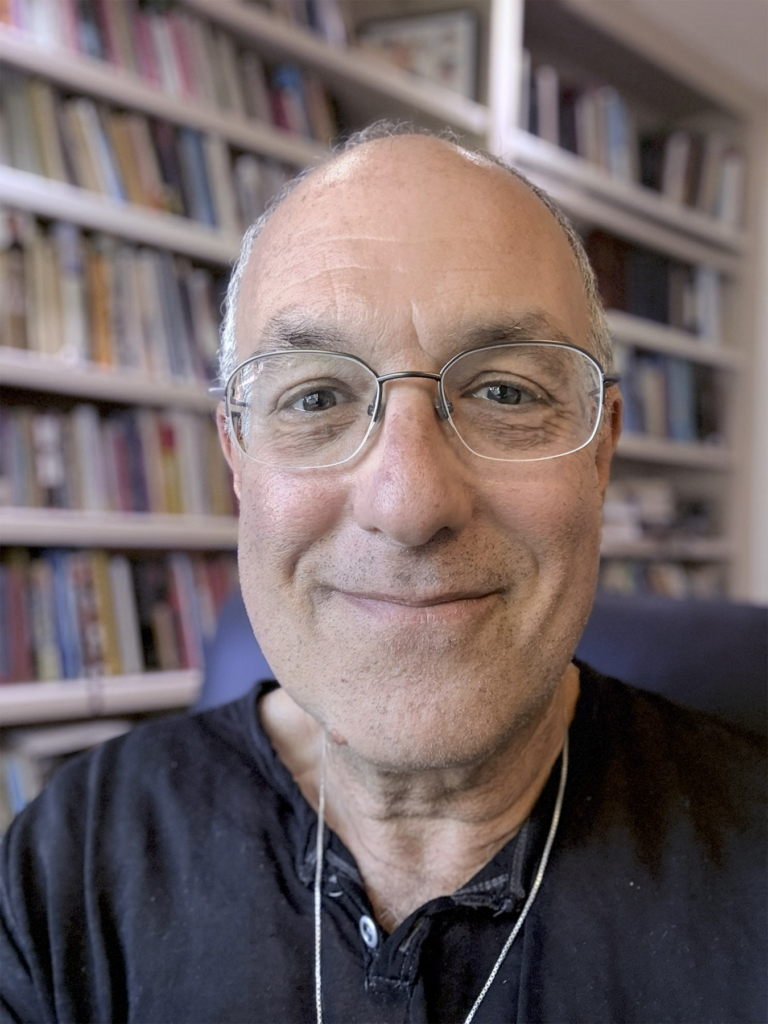
Astor says their study confirms the healthy context paradox, which exists even when incidents of bullying are addressed, but still leaves the victim feeling a lack of resolution or safety because the bias aspect was never addressed.
“When you look at other literatures on prejudice, in the women’s victimization literature and some of the others, the idea of naming the reason why you were victimized is critical,” he says. “It’s not only the response – it’s hinges on how the schools response specifically addresses why you were victimized. Astor predicts that if schools did this, a positive school climate could benefit these students as well.
“It could very well be that schools are having programs on social-emotional learning and restorative justice, but they’re doing it on a very interpersonal basis,” says Professor Astor. “They may not be saying in situations involving bias victimization, for example, ‘the reason why you picked on this person is because you thought they were gay.’ If schools only look at the behavioral interaction, [between the perpetrator and the victim] they may walk away feeling like, okay, but this is gonna happen again because of who I am. If a kid is part of an immigrant group and victimization happens, but they believe that it happened because they were an immigrant and the reason behind the victimization is not discussed, a positive school climate may not help–they may not get better and stay depressed and alienated, even if the behavioral conflict itself is resolved.”
The article proposes for interventions and future research on the topic, such as access for school leaders to accurate information on the kinds of bias detected on their campuses. Astor says that it is possible for students and teachers to have very specific prejudices, such as a campus that exhibits tolerance for people of different faiths but also expresses homophobia.
“If we drill down and really see what’s happening at each school, they can tailor how they educate their population about specific stereotypes they have about different groups, and that can help the level of bias go down,” he says.
Professor Astor expresses his gratitude for the award and hopes that the exposure of his team’s work will further discussion, best practices, and research.
“I’m very proud of our group,” he says. “We love awards because more more people will take a look at our work and think about it and consider it. It’s a wonderful opportunity to have it amplified further and for people to see what we did, to think of what they can do to make our world better.”
For a list of Professor Astor’s research presentations at AERA’s annual meeting, visit the conference website.
To learn more about Professor Astor’s work, visit the UCLA Luskin website.
Kourtney Kawano, assistant professor of education at UC Berkeley, has been honored with the Distinguished Dissertation Award from AERA’s Division G- Social Context of Education. The UCLA alumna, who was mentored by Professors Daniel Solórzano and Robert Teranishi, was recognized for her work on “It Runs in the ʻOhana: Examining Resistance to Internalized Oppression Among Kanaka ʻŌiwi Students and Families,” drawing from her experiences growing up in a Kanaka ʻŌiwi (Native Hawaiian) community and interviewing generations of subjects like her.
Kawano’s dissertation focuses on everyday discourses and interaction among Native Hawaiian students, particularly in family context and settings.
“I was curious about … the variety of different familial experiences while centering some of the patterns and trends that come from living in one particular community that always has had a deficit perspective cast upon it… to instead push back through a critical race theoretical lens and my own cultural-based perspective of the strengths that exist within this community,” says Kawano. “A lot of it ended up supporting deep, intimate conversations around issues stemming from historical trauma and intergenerational teaching and learning as a means to counter some of the ongoing effects of colonialism and military occupation.”
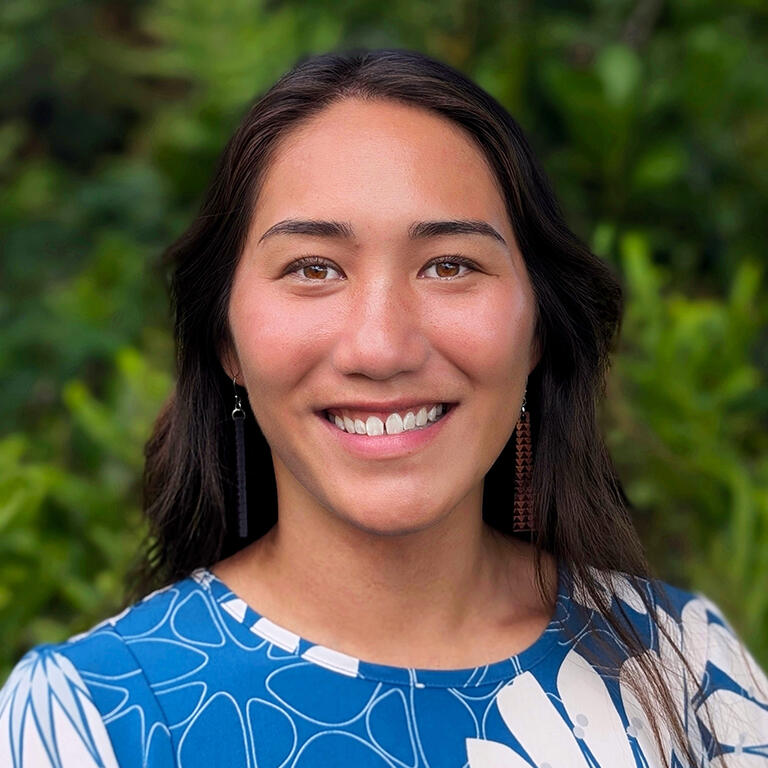
Being Kanaka ʻŌiwi herself, Kawano says that her interactions with research subjects were enhanced by her own insider knowledge.
“Being able to have familiarity with the same roads that we drive every day, the beaches that we go to, the schools … having intimate knowledge of the neighborhoods and the everyday routines that families were speaking of, really helped create the sense of intimacy that helped us dive deeper into truly impactful experiences and memories of what happened to Native Hawaiian people in the past and some of the legacies that still affect families and children to this day.
“A particular conversation and observation that I always remember from this project is one in which a mother and daughter were recalling their experience of conducting a family research project and finding birth certificates of their ancestors that documented the change in Hawaiʻi [from] a kingdom to a territory to a state, and as children, and not understanding the gravity of that,” says Kawano.
“When they matured and had familiarity with Hawaiian history, [they knew] the context … the eventual laws that governed and explained how Hawaiʻi went from those different statuses, and the impact that had on our people when it came to language and culture. These real everyday experiences [are] something that I continue to sit with. This mother and daughter spoke so emotionally about it and getting to that point really depended on that intimate relationship and familiarity, and the sense that I as interviewer and researcher, could hold those stories and could be trusted to share them in an ethical and strengths-based way.”
A double Bruin (’21, MA, Education; ’25, PhD, Education – Social Sciences and Comparative Education), Kawano says she looks forward to AERA and “sharing our work and making sure it’s received well and that it generates conversations and helps us move our work forward.
“At the same time, there’s always such energy around reconnecting with people,” she says. “For me personally, I’m excited to see both my mentors [and] other members of my cohort and all the amazing friends that I’ve made over my time in the UCLA program. This will be the first time that I will get to attend AERA when LA is hosting the conference. Even though I lived in L.A. for two of the years of my program and got to learn a lot about Westwood, I don’t have that much familiarity with LA in general, so I’m excited to get to explore and celebrate everyone’s accomplishments.
“I’m really proud to be a graduate of UCLA and I frame my time there as the development of lifelong friends, sister scholars and mentors,” says Kawano. “It really did change my life and my trajectory, so every time I get a chance to be near folks from UCLA, I always treat it as such a privilege.”
Visit the AERA website for a list of Kourtney Kawano’s presentations during the Annual Meeting.
Eric Ho, lecturer in the UCLA Department of Education, has been honored with the 2026 Palmer O. Johnson Memorial Award for his co-written article, “No Matter How You Slice It, Black Students are Punished More: The Persistence And Pervasiveness of Discipline Disparities,” which was published in AERA Open in 2024. Ho and his co-author, Sean Darling-Hammond, assistant professor of community health sciences at the UC Berkeley School of Public Health, will be recognized at the awards luncheon during AERA’s Annual Meeting in Los Angeles, Apr. 8-12.
“I am deeply honored to receive this award,” says Ho. “I hope that our work will inspire other researchers to continue research into educational disparities and investigate ways to address these disparities.”
Ho and Darling-Hammond examined data from the Civil Rights Data Collection and from the Common Core of Data from the National Center for Education Statistics, which includes information on disciplinary measures such as out-of-school suspensions, in-school suspensions, expulsion rates, and corporal punishment. The data, which was disaggregated by race, helped the authors to clearly show the disparities in disciplinary outcomes for Black students, white students, and non-Black students in a variety of school settings, including magnet schools, charter schools, and schools with high percentages of free or reduced lunch students.
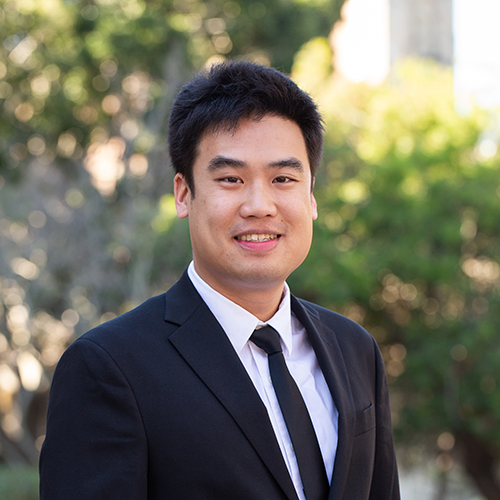
An alumnus of the UCLA School of Education and Information Studies (’19, MA, Education; ’23, PhD, Social Research Methodology) Ho joined the school’s faculty as a lecturer in 2024, and is also the Data Scientist for Enrollment Management at Caltech. Previously, he has worked as a statistician for the Office for Civil Rights within the U.S. Department of Education.
Ho looks forward to connecting with Darling-Hammond and other colleagues from his UCLA cohort as a student. He encourages students in the UCLA Department of Education to attend AERA, which for the first time in 35 years is being held in Los Angeles.
“It’s really a very unique opportunity, especially since it’s pretty much at their doorstep,” says Ho. “Make every effort to go, and just stay curious, really. I would really try to take the opportunity to learn about work that’s outside of my field. I do a lot of quantitative work but I keep an open mind and try to learn as much about other things that I may not be familiar with, such as ethnographies or other qualitative work.
“I would really encourage students to expand their horizons and take a leap and learn about things that you may not have considered before,” says Ho. “I’m not sure in what other situations you’d be able to do this when you’re a doctoral student. You’re kind of locked into, ‘oh, I have to fulfill my course requirements, I need to study for my comprehensive or qualifying exams, and I need to do my dissertation.’ You get pigeonholed into your specific discipline, and I feel like it’s doing a disservice to yourself without learning what other things are out there for you to learn.”