Scholar of the impact of minority-serving institutions joins panel of experts to highlight the academic, economic, and social impacts of ending federal funding to institutions that serve millions of students.
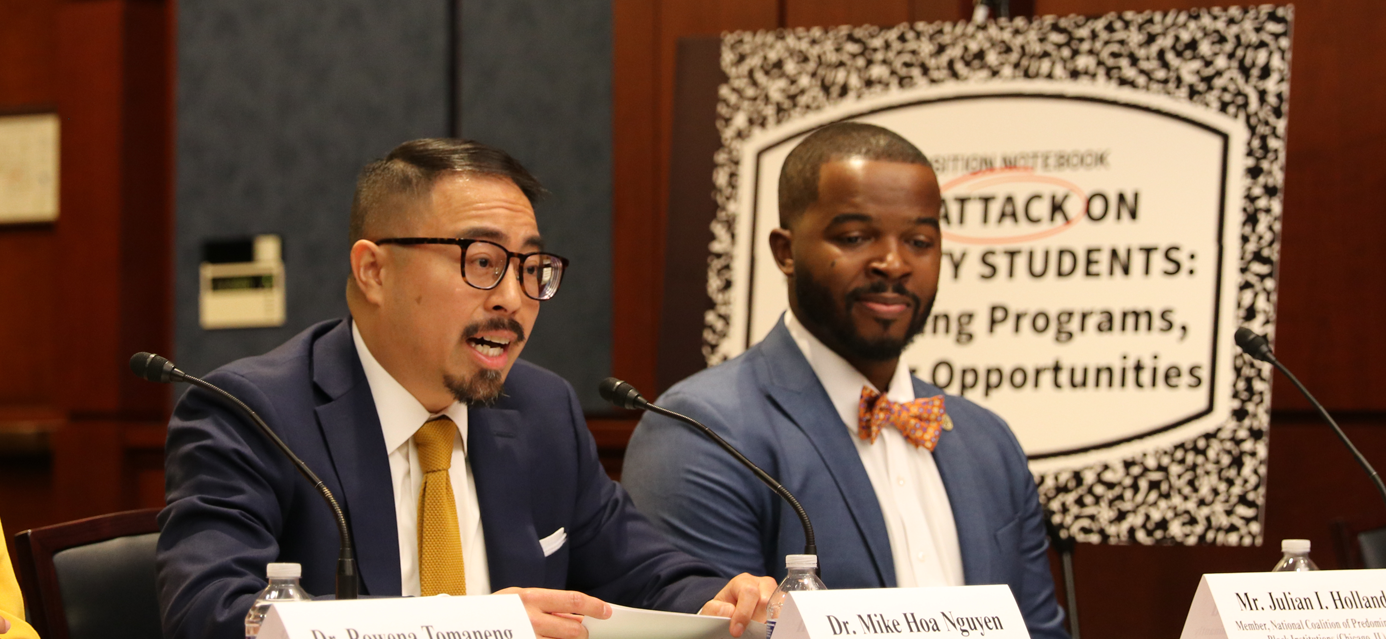
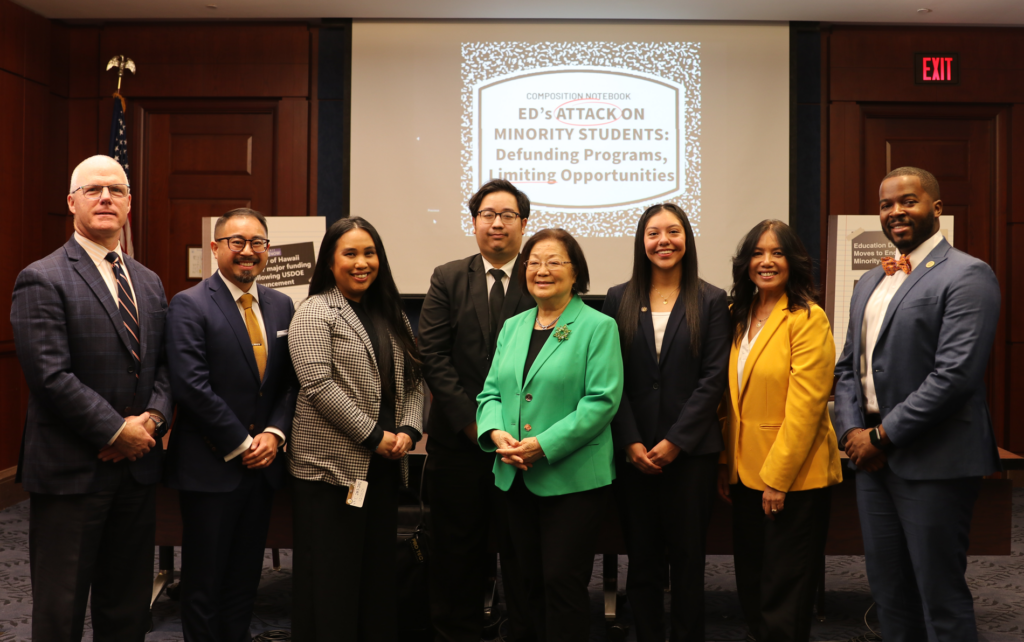
Mike Hoa Nguyen, associate professor of education, testified in the U.S. Senate on “The Role and Significance of Minority-Serving Institutions in American Higher Education” during a spotlight forum on Feb. 26, led by Senator Mazie K. Hirono (D-HI), focused on the U.S. Department of Education’s efforts to eliminate funding for Minority-Serving Institutions (MSIs).
The spotlight forum focused on the end of federal funding to MSIs that will diminish these institutions’ ability to serve all students regardless of background. Professor Nguyen joined a panel of witnesses comprised of university faculty and students, policy experts, and legal analysts with firsthand experience with the devastating impacts of defunding these programs, including John D. Keenan, president of Salem State University; Jo Ann Paanio, policy director, National Council of Asian Pacific Americans; Rowena M. Tomaneng, president, Asian Pacific Americans in Higher Education; and Julian Holland, a member of the National Coalition of Predominantly Black Institutions.
Professor Nguyen, who is the principal investigator of The Minority-Serving Institutions Data Project, delineated for senators the history of MSIs and their impact on educational and career outcomes for students from the most underserved communities over the past 40 years.
Nguyen acknowledges Congress’ formal establishment of 11 unique MSI designations, which include service to Alaska Native, Asian American, Black, Hispanic, tribal and non-tribal Native American, Native Hawaiian, and Pacific Islander populations. He notes that only one in five higher education institutions is eligible for MSI funding, yet they enroll more than half of the nation’s undergraduate students of color, with the most accessible and affordable pathway to higher education for diverse student populations.
Nguyen says that while many colleges and universities had enrolled and supported the educational advancement of students of color in both formal and informal ways, the federal designation of MSIs “not only signaled a real and tangible federal commitment to serving and supporting our students, but it also provided much-needed resources to these often under-resourced institutions.”
Professor Nguyen says that the work of MSIs has resulted in some of the largest enrollments, degree completions, and positive labor market outcomes in the country.
“MSIs enroll over five million students and achieve these outcomes because they are true sites of innovation,” he says. “The federal funding appropriated to them directly enhances their ability to implement vital interventions to improve academic and student support services, deliver culturally relevant co-curricular programming, and expand their research capacity.
Nguyen’s expertise as a researcher is complemented by his nearly seven years as a staff member in the Office of U.S. Congressman Michael M. Honda before pursuing his PhD at UCLA. He says, “As researchers, we want our work to inform policymakers. When I think of a research agenda, I intentionally rely on my Congressional experience to help inform my questions.
“This is embedded throughout the process,” Nguyen says. “It allows me to easily share my findings with policymakers because it’s designed with their utility in mind, in addition to what the MSI community is telling me is important – multiple stakeholders help me design the research study.”
Nguyen’s research demonstrates that MSIs account for some of the largest enrollments, degree completions, and positive labor market outcomes in the country and achieve these outcomes as true sites of innovation.
“The federal funding appropriated to them directly enhances their ability to implement vital interventions to improve academic and student support services, deliver culturally relevant co-curricular programming, and expand their research capacity,” said Nguyen. “And they do so in ways that actively embrace students’ identities, lived experiences, as well as their families and communities. This not only heightens students’ academic and professional trajectories, but it increases their sense of belonging, identity development, and civic engagement; all of which in turn have profound positive effects on personal growth and key academic outcomes, such as college retention, persistence, community college transfer, and completion.”
Professor Nguyen achieved his doctorate (’19, PhD, Higher Education and Organizational Change) at what was then the UCLA Graduate School of Education and Information Studies and returned to join the faculty at his alma mater in 2025.
Nguyen was appointed to the first-ever Historically Black Colleges and Universities and Minority-Serving Institutions Federal Advisory Council at the U.S. Environmental Protection Agency during President Biden’s administration, while an assistant professor at New York University. Nguyen was also appointed by the governor of Colorado to the state’s History, Culture, Social Contributions, and Civil Government in Education Commission when he was an assistant professor at the University of Denver. Professor Nguyen currently serves on the boards of Asian Pacific Americans in Higher Education and the Southeast Asia Resource Action Center.
“Given the outsized role MSIs play in providing educational access and opportunity, coupled with new challenges arising from recent targeted executive actions, I am grateful this body is increasing its focus on how MSIs serve their students,” says Professor Nguyen. “I’m thankful for the opportunity to highlight the research that demonstrates the many positive outcomes they generate, and to ensure that MSIs continue to receive the necessary federal resources to do this vital work.”
For video of Senator Hirono’s full spotlight forum on Feb. 26, click here.
For national coverage of the event, visit these links.
National Today – Los Angeles Today
Above: Official U.S. Senate Photo by Ryan Donnell